What Is Width and How Do You Measure It Correctly in Different Contexts?
Width is the measurement of an object from side to side, typically taken at a 90-degree angle to its length. In basic geometry, width is often defined as the shorter dimension of a two-dimensional shape, while length represents the longer dimension. However, in professional fields like printing and digital design, width refers to the horizontal span (left-to-right) regardless of whether it is the longest side.
Understanding the concept of width might seem straightforward at first glance, but it is a dimension that changes its meaning based on your perspective, your industry, and even the medium you are working in. Whether you are a student solving a geometry problem, a homeowner measuring for new curtains, or a digital designer creating a responsive website, knowing how to define and measure width accurately is essential for success.
According to Math.net, width is a fundamental linear measurement that helps define the extent of an object in space. While we often use it interchangeably with terms like "breadth," the specific application of width can vary significantly between a 2D rectangle on a piece of paper and a 3D box sitting in a shipping warehouse.
What Is the Basic Geometric Definition of Width?
In the realm of pure mathematics and geometry, width serves as one of the primary coordinates used to calculate area and volume. For two-dimensional shapes, such as rectangles and parallelograms, width is one of the two dimensions required to understand the shape's total surface area. The standard convention in many classrooms is that the width is the shorter side, while the length is the longer side.
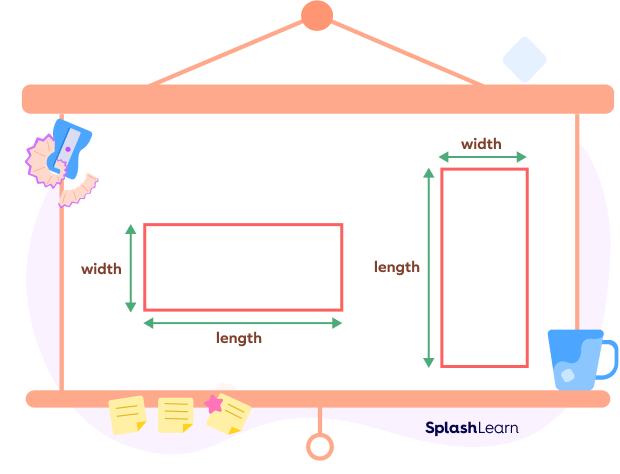
Image source: SplashLearn
This "Shortest Side Rule" helps students distinguish between the two dimensions when looking at a static shape on a page. For example, if you have a rectangle that is 10 inches by 4 inches, most mathematicians would label the 4-inch side as the width. This relationship is codified in the classic formula for area: Area = Length × Width. As noted by Mathnasium, this measurement must always be taken at a 90-degree angle (perpendicular) to the length to ensure accuracy.
Width in Three-Dimensional Space
When we move from 2D shapes to 3D objects, such as rectangular prisms or cubes, the definition becomes slightly more complex. In a 3D context, we introduce a third dimension: height. Traditionally, width remains the side-to-side measurement, while height is the vertical measurement, and depth (or length) is the front-to-back measurement. However, if you rotate the object, the labels often shift, even though the physical dimensions of the object remain the same. This leads to what professionals call the "Orientation Paradox."
How Does Width Differ from Length Height and Depth?
The confusion between width, length, height, and depth usually stems from the viewer's perspective. Unlike height, which is almost always fixed to the vertical axis (up and down), width and depth are often relative to where you are standing.
Width vs. Length
In many contexts, length is the "longitudinal" measure (the direction something travels), while width is the "transverse" measure (across the object). A road's width is the distance between the curbs, even if the road is miles long.
Width vs. Height
Height is strictly vertical. If you are looking at a door, the distance from the floor to the top is the height, while the distance from the left hinge to the right edge is the width.
Width vs. Depth
This is the most common source of error. In furniture, width is usually the span across the front, while depth is how far back the piece goes. If you turn a bookshelf sideways, its "width" effectively becomes its "depth."
Experts at The Math Doctors point out that "English starts with its speakers, not lexicographers." This means that while a textbook might say width is the shortest side, a person measuring a "wide-screen" television will call the longest horizontal side the width. This highlights the importance of context over rigid rules.
The String Paradox
Consider a ball of yarn or a spool of ribbon. We almost always talk about the "length" of the ribbon in terms of how much utility it provides (e.g., a 50-foot roll). However, the "width" of the ribbon (e.g., 2 inches) is a fixed physical characteristic of the product itself. In this case, width is not the "shorter side" of a rectangle, but a defining attribute of the material's transverse span.
Why Does the Order of Measurements Matter in Professional Industries?
If you have ever ordered a custom picture frame or a vinyl banner, you may have noticed that the order of numbers matters immensely. Swapping the width and height can result in a product that is oriented incorrectly, leading to wasted materials and costs.
| Industry | Standard Order | Primary Focus |
|---|---|---|
| Graphics & Printing | Width x Height (W x H) | Visual orientation (Landscape vs. Portrait) |
| Shipping & Logistics | Length x Width x Height (L x W x H) | Volume and stacking efficiency |
| Architecture/Construction | Width x Depth x Height | Floor space and clearance |
| Mathematics | Length x Width (L x W) | Calculating surface area |
In the printing world, the rule is generally "Width First." As explained by High Resolutions, this standard aligns with how we read (left-to-right) and how design software like Adobe Photoshop or Illustrator handles canvas dimensions. An 8x10 print is 8 inches wide and 10 inches tall (Portrait), whereas a 10x8 print is 10 inches wide and 8 inches tall (Landscape).
How to Measure Width for Digital Screens and UI Design
In the modern era, width is no longer just about inches or centimeters. For web developers and UI/UX designers, width is a dynamic variable that changes based on the device being used. This is known as responsive design.
Pixels vs. Viewport Units
Digital width is measured in several ways:
- Pixels (px): A fixed unit of measurement. A container that is 500px wide will always be 500px, regardless of the screen size.
- Viewport Width (vw): A relative unit where 1vw is equal to 1% of the width of the browser window. This allows elements to scale fluidly as a user resizes their window.
- Percentage (%): Defines width relative to the parent container.
One of the significant advancements in design tools like Figma is the ability to use "Width Variables." However, this can lead to technical hurdles. Users often encounter issues where "Auto Layout" settings conflict with fixed width variables, causing components to break when they are resized or swapped. Understanding the relationship between "Fixed Width," "Hug Contents," and "Fill Container" is a top-tier skill for modern designers.
Advanced Concepts of Width in Audio Engineering and Logic
Width isn't always a physical distance you can touch. In specialized fields, it refers to the "spread" or "relationship" between elements.
Stereo Width in Music Production
In audio engineering, "width" refers to the perceived spatial spread of a sound between the left and right speakers. A "wide" mix feels immersive, as if the instruments are surrounding the listener, while a "narrow" mix feels like the sound is coming from a single point in the center. According to Mastering The Mix, achieving stereo width involves techniques like panning, using the Haas Effect (a short delay between left and right channels), and frequency balancing. It is a relational perception rather than a linear measurement.
Width in Logical Patterns (Sudoku W-Wings)
In the world of competitive Sudoku, "width" appears in the form of the **W-Wing**. This is a notably innovative strategy used to eliminate candidate numbers from cells. A W-wing consists of two identical bi-value cells (cells that only have two possible numbers) that are connected by a "strong link" in a different part of the grid. This logical "bridge" creates a width of influence that allows a player to prove that a specific number cannot exist in certain cells. As detailed by Sudoku Bliss, mastering these "wings" is a significant step forward for players moving from intermediate to advanced levels.
Common Mistakes People Make When Measuring Width
Even with a ruler in hand, it is easy to make errors if you don't follow a consistent methodology. Here are the most frequent pitfalls:
- Confusing Girth with Width: Girth is the circumference or the distance *around* an object. Width is a straight-line cross-section. If you are shipping a tube, the width is the diameter, not the distance around the circle.
- The Rotation Trap: Failing to define the "front" of an object before measuring. Always decide which side is the "face" of the object first; the horizontal measurement of that face is your width.
- Ignoring Irregularities: When measuring an irregular object (like a kidney-shaped table), use the "Bounding Box" method. Imagine the smallest possible rectangle the object could fit inside; the width of that rectangle is the object's width.
- Measuring Round Objects: For circles, width is identical to the diameter. However, for ovals, you must specify if you are measuring the "major axis" (longest width) or "minor axis" (shortest width).
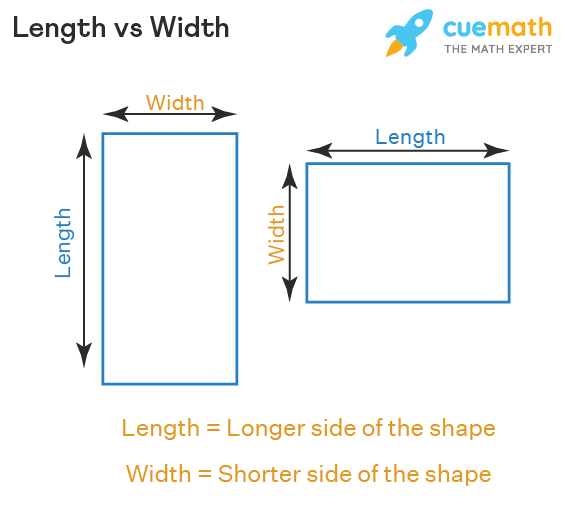
Image source: Cuemath
Frequently Asked Questions
- Does width always come before height in measurements?
- In the graphics, printing, and digital design industries, the standard is almost always Width x Height (W x H). This helps designers quickly identify if an image is in landscape or portrait orientation. However, in shipping and construction, the order is often Length x Width x Height (L x W x H). It is always best to clarify the standard being used before placing an order.
- Is width the same thing as breadth?
- Yes, "width" and "breadth" are synonyms and can be used interchangeably in most contexts. "Breadth" is often used in more literary or formal settings (e.g., "the breadth of the horizon"), while "width" is the standard term used in mathematics, science, and everyday construction.
- Can the width of an object be longer than its length?
- In a strict geometric sense for a rectangle, the length is traditionally the longer side. However, in real-world applications, width can certainly be the longer dimension. For example, a "wide-format" banner might be 10 feet wide but only 3 feet tall. In this case, the horizontal measurement is the width, even though it is longer than the vertical height.
- How do you measure the width of a circular object?
- To find the width of a circle, you measure the diameter—the straight line passing through the center of the circle from one side to the other. If the object is a sphere, the width is the same regardless of the angle, provided you measure through the center point.
- What is the difference between width and thickness?
- Thickness usually refers to the smallest dimension of a three-dimensional object, particularly for flat materials like wooden boards, sheets of metal, or paper. While width describes the side-to-side span, thickness describes the depth of the material itself. For example, a plank of wood might be 4 inches wide and 1 inch thick.
Key Takeaways for Measuring Width
- Perpendicular Rule: Width must always be measured at a 90-degree angle to the length to be mathematically accurate.
- Industry Standards: Remember "Width First" (W x H) for design and "Length First" (L x W x H) for shipping to avoid errors.
- Perspective Matters: Width is often relative to the viewer; always define the "front" of an object before labeling its dimensions.
- Digital Context: In web design, width is often relative (using % or vw) rather than a fixed number of pixels.
- Conceptual Width: In audio and logic, width refers to the spread or relationship between points, not just physical distance.
- Bounding Box Method: Use an imaginary rectangle to measure the width of irregular or organic shapes.
Before starting your next project, take a moment to confirm which measurement standard your industry requires to ensure your dimensions are interpreted correctly by everyone involved.