What Is a Resume Summary and How Do You Write a Powerful One?
A resume summary is a concise, 2–5 sentence professional "elevator pitch" located at the top of your resume. It highlights your most relevant skills, years of experience, and key achievements to immediately demonstrate your value to a recruiter. Unlike an objective, which focuses on what you want, a summary focuses on what you offer the employer.
What Exactly Is a Resume Summary?
In the modern job market, your resume has roughly six seconds to make an impression. According to eye-tracking research, recruiters spend the majority of their initial scan on the top third of the page. This is where the resume summary—also known as a professional profile or summary of qualifications—becomes a critical tool for success.
A resume summary serves as a curated highlight reel. Instead of forcing a hiring manager to hunt through your work history for evidence of your expertise, you present your "greatest hits" right at the start. It typically consists of a short paragraph or a few high-impact bullet points that summarize your career trajectory and specialized skills (Indeed, 2026).
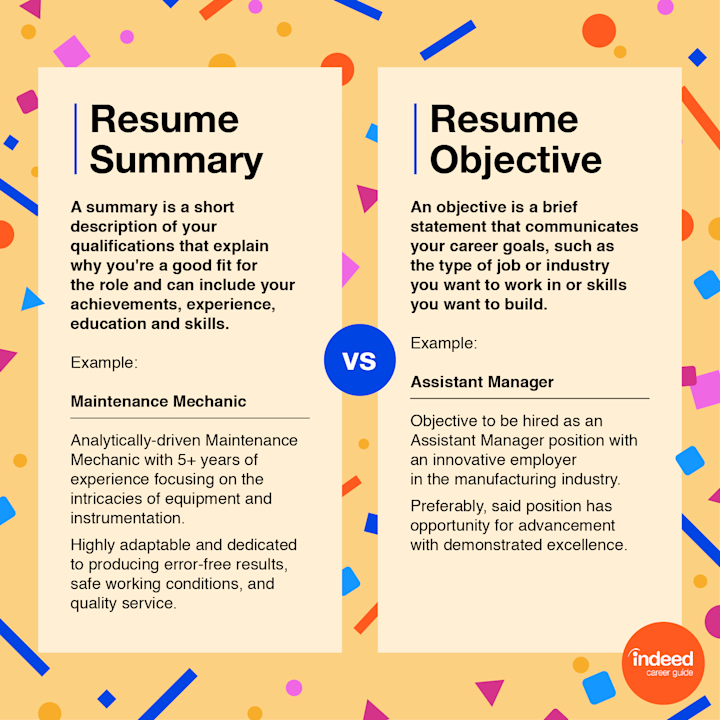
Image source: Indeed
The core purpose of this section is to answer one question for the employer: "Why should we keep reading?" By lead-in with your years of experience, a specific industry title, and a quantifiable achievement, you establish immediate credibility. It is widely considered a top-tier choice for professionals with at least two years of experience, as it provides a narrative thread that connects disparate roles into a cohesive professional identity.
Resume Summary vs Objective — Which One Should You Use?
One of the most frequent points of confusion for job seekers is the difference between a resume summary and a resume objective. While they occupy the same real estate on the page, their intent is fundamentally different. In 2026, the shift toward employer-centric resumes has made the summary the standard for most professionals.
| Feature | Resume Objective | Resume Summary |
|---|---|---|
| Primary Focus | Your career goals and what you want to learn. | Your proven skills and what you offer the company. |
| Content | Aspirational statements (e.g., "Seeking a role to grow..."). | Evidence-based achievements (e.g., "Increased sales by 20%"). |
| Best For | Entry-level students or total career pivots. | Experienced professionals and mid-career changers. |
| Recruiter Value | Low — focuses on the candidate's needs. | High — focuses on solving the employer's problems. |
As noted by Duke University, objectives are increasingly viewed as outdated because they take up valuable space without providing proof of competence. However, if you are a recent graduate with no internships or a professional making a radical industry shift (e.g., moving from retail to software engineering), a modified objective or "summary of transferable skills" may still be appropriate.
How to Write a Resume Summary Using a Proven 3-Step Formula
Writing a summary from scratch can feel daunting. To avoid the "vague language trap," follow this structured formula used by professional resume writers to ensure every word earns its place on the page.
-
The Professional Identity Header
Start with a bolded title that matches the job you are applying for. For example: SENIOR PROJECT MANAGER. This immediately categorizes you in the recruiter's mind. Follow this with your years of experience and your core area of expertise. Avoid using personal pronouns like "I" or "me"; instead, use strong, active phrasing.
-
The Credibility Statement & Key Skills
In the second sentence, weave in 3–4 of your most relevant hard skills. These should be pulled directly from the job description to ensure you pass Applicant Tracking System (ATS) filters. If the job requires "Agile Methodology" and "Budget Oversight," these must appear here. This section sets a high standard for your technical proficiency.
-
The Quantifiable Win (The "Hook")
This is the most important part of the formula. Include a specific metric or achievement that proves you can do the job. Instead of saying you are "good at sales," say you "consistently exceeded quarterly targets by 15% over a three-year period." Data points provide the "proof of work" that recruiters crave (EPUD, 2026).
Finally, conclude with a brief value proposition: a statement on how you intend to solve the employer's specific pain points. This shows you have researched the company and understand their current challenges.
Formatting Your Summary for Maximum Readability
Even the most well-written summary will fail if it looks like a "wall of text." You have two primary options for formatting, and your choice should depend on your industry and the amount of technical data you need to convey.
The Paragraph Style
The traditional paragraph style (3–5 lines) is an excellent choice for roles that require strong communication and narrative skills, such as Marketing, HR, or Executive leadership. It allows you to tell a brief story about your career progression. The key is to keep it tight—aim for the "Goldilocks Zone" of 50–60 words. Anything longer risks being skipped entirely.
The Bulleted/Hybrid Style
For highly technical roles (IT, Engineering, Data Science), a hybrid approach is often more effective. You might start with a single introductory sentence followed by 3–4 bullet points highlighting specific technical stacks or certifications. This format is exceptionally strong for quick scanning, as it breaks up the visual density of the page.
"The summary is the only place on a resume where you can truly control the narrative. While the rest of the resume is a list of facts, the summary is your chance to tell the recruiter exactly who you are before they form their own conclusions." — Recruiter Insight from Community Discussions
Resume Summary Examples for Every Career Stage
To help you visualize these concepts, here are several examples tailored to different professional situations. Notice how each one avoids fluff and focuses on concrete value.
Digital Marketing Manager with 7+ years of experience in e-commerce growth. Proven track record of managing $50k+ monthly ad spends and increasing organic traffic by 40% year-over-year. Expert in SEO, SEM, and HubSpot integration, focused on driving high-intent lead generation for SaaS companies.
Chief Operations Officer with 15+ years of experience scaling global manufacturing firms. Spearheaded a digital transformation initiative that reduced operational overhead by $2.4M annually. Expert in P&L management, cross-functional leadership, and lean six-sigma methodologies.
Aspiring Data Analyst transitioning from a 5-year career in Retail Management. Leveraged advanced Excel and SQL skills to optimize inventory turnover by 12% in previous role. Recently completed a Professional Data Analytics Certification, specializing in Python and Tableau to drive data-informed business decisions.
Bilingual Communications Graduate with internship experience at a top-tier PR firm. Developed social media content that reached 100k+ unique users and assisted in the execution of three national product launches. Strong foundation in media relations, copywriting, and crisis management.
How to Optimize Your Summary for Applicant Tracking Systems (ATS)
In 2026, nearly 99% of Fortune 500 companies use Applicant Tracking Systems to filter resumes before a human ever sees them. Your summary is a prime location for "keyword weaving"—the process of naturally integrating job-specific terms into your narrative.
Instead of simply listing skills at the bottom of your resume, the summary allows you to put those keywords into context using the PAR Method (Problem-Action-Result). For example, if "Project Management" is a key requirement, don't just write the phrase. Write: "Managed (Action) complex construction projects (Problem) resulting in 100% on-time delivery (Result)."
Avoid "Fluff Filters." Words like "visionary," "hard-worker," or "team player" are often ignored by ATS algorithms and viewed as "cringe-worthy" by recruiters (Clark College, 2026). Replace these adjectives with industry-specific nouns and verbs that describe your actual functions.
Common Pitfalls That Make Recruiters Skip Your Resume
Even a well-intentioned summary can backfire if it falls into these common traps. Awareness of these mistakes is a significant step toward a more professional application.
- The "Tell-All" Mistake: Your summary should be a "hook," not a full biography. If it exceeds 75 words, you are likely including details that belong in your work history section.
- The First-Person Error: Using "I," "me," or "my" makes the summary feel less professional and more like a cover letter. Stick to the "implied first person" (e.g., "Led a team" instead of "I led a team").
- Vague Superlatives: Claiming you are "the best in the industry" without proof is a red flag. Use evidence-based phrasing like "consistently ranked in the top 5% of the sales force."
- Writing It Too Early: Many experts recommend writing the summary last. Once you have finished your work history and skills sections, you will have a clearer picture of your "best hits" to include in the intro.
The 5-Point Summary Audit
Score your current draft. If you can't check all five, it's time for a rewrite:
- Does it start with a bolded professional title?
- Is the first word of the second sentence a strong action verb?
- Does it include at least one quantifiable metric (%, $, #)?
- Have all "I/Me/My" pronouns been removed?
- Is it tailored to at least 3 keywords from the job post?
Frequently Asked Questions
How long should a resume summary be?
A resume summary should typically be between 2 and 5 sentences, or approximately 50 to 60 words. The goal is to provide enough information to be impactful without taking up so much space that the recruiter loses interest before reaching your work history. If you have more than 15 years of experience, you might lean toward the 5-sentence limit; for those with less experience, 2–3 sentences is a top-tier choice.
Can I use bullet points in my summary?
Yes, bullet points are highly recommended for technical roles or when you have several distinct achievements that are hard to weave into a single paragraph. A common "hybrid" format involves one introductory sentence followed by three high-impact bullet points. This improves readability and ensures your key metrics stand out during a quick scan.
Do I need a summary if I have no experience?
If you are a student with no internships or work history, a resume objective or a "Summary of Skills" is often more appropriate. However, if you have relevant coursework, volunteer experience, or significant academic projects, you can still use a summary to highlight these "transferable skills." The key is to focus on what you have learned and how it applies to the role.
Should I change my summary for every job application?
Absolutely. Tailoring is mandatory for modern hiring. You should adjust the professional title to match the job listing and swap out your key skills to match the specific requirements of the employer. This not only helps with ATS optimization but also shows the hiring manager that you are a specific fit for their unique needs.
What is the difference between a professional profile and a resume summary?
In the context of modern resume writing, these terms are essentially the same. "Professional Profile," "Summary of Qualifications," and "Resume Summary" all refer to the introductory section at the top of the page that highlights your career achievements. Some industries prefer one term over the other, but the content and structure remain identical.
Final Thoughts
A well-crafted resume summary is your only chance to control the narrative of your career before a recruiter dives into the raw data of your work history. By focusing on what you offer rather than what you want, you position yourself as a solution-oriented professional from the very first sentence.
- 1. Placement matters: Always keep your summary in the top third of the first page.
- 2. Quantify everything: Use numbers, percentages, and dollar amounts to provide proof of your impact.
- 3. Match the job: Use the exact professional title found in the job description.
- 4. Avoid the "I": Write in the third person to maintain a formal, professional tone.
- 5. Keep it brief: Aim for the 50–60 word "Goldilocks Zone" to ensure maximum readability.
- 6. ATS is watching: Weave keywords naturally into your sentences using the PAR method.
Take a moment today to read your current summary aloud; if it sounds like a list of chores rather than a list of wins, use the 3-step formula above to rewrite it.