What Is a Keynote Address and How Does It Set the Tone for an Event?
A keynote address is a primary speech delivered at a gathering—such as a conference, convention, or graduation—that establishes the underlying theme and core message of the event. Derived from the musical practice of playing a single note to set the key for a choir, the keynote serves as the intellectual and emotional "pitch" for all subsequent sessions. It is typically delivered by an authority figure or expert and is designed to inspire, unify, and provide a framework for the audience's experience.
In the world of professional events, few elements carry as much weight as the keynote address. Whether it is a high-stakes political convention, a global tech summit, or a local university commencement, the keynote is the anchor that prevents the event's message from drifting. It is not merely a presentation of facts; it is a distillation of wisdom intended to move an audience from a state of passive listening to active engagement.
Understanding the nuances of a keynote address is essential for event organizers, aspiring speakers, and attendees alike. While many use the term interchangeably with "guest speech" or "plenary session," there are distinct technical and strategic differences that define a true keynote. This guide explores the historical origins, the structural requirements, and the professional logistics that make a keynote address a top-tier component of any successful gathering.
The Core Definition and Purpose of a Keynote Address
At its heart, a keynote address is the "theme-setter." According to Merriam-Webster, the term refers to an address designed to present the issues of primary interest to an assembly. However, the functional purpose goes far beyond a simple introduction. A successful keynote creates a shared vocabulary and a common goal for thousands of people who may have arrived with vastly different expectations.
The Musical Etymology
The term "keynote" originates from the world of a cappella and barbershop music. Before a group begins to sing, a "key note" is played—often on a pitch pipe or tuning fork—to ensure every singer starts in the same musical key. Without this initial note, the harmony would likely collapse into discord. In the context of an event, the speaker provides this "pitch," ensuring that every breakout session, panel discussion, and networking lunch resonates with the same core values and objectives.
Historical Milestone: 1863
The phrase "keynote address" has deep historical roots, with its first recorded use dating back to 1863. During this era, particularly in American political discourse, the keynote became a vital tool for party leaders to align their base around a singular vision. This historical context reinforces the idea that a keynote is not just a speech, but a leadership moment. It is an opportunity to signal a shift in direction or to solidify a long-standing tradition.

Image source: LinkedIn
Keynote Address vs Plenary Session — What Is the Real Difference?
One of the most common points of confusion in event planning is the distinction between a "keynote" and a "plenary session." While they often happen at the same time, they describe two different aspects of the event. A plenary session is a logistical format, while a keynote is a specific type of content. According to Wikipedia, a plenary session is a session of a conference which all members of all parties are expected to attend.
In other words, you can have a plenary session that is not a keynote. For example, a town hall meeting where the CEO answers questions from the entire company is a plenary session, but it may lack the thematic, inspirational qualities of a keynote address. Conversely, a keynote is almost always delivered during a plenary session because its purpose is to reach the entire audience at once.
| Feature | Keynote Address | Plenary Session |
|---|---|---|
| Primary Goal | Set the theme and inspire | Ensure all attendees hear the same info |
| Content Type | Narrative, wisdom, and vision | Updates, panels, or business data |
| Speaker | Expert, celebrity, or visionary | Internal leaders, panels, or staff |
| Audience | Entire assembly | Entire assembly |
How a Keynote Address Differs From a Standard Presentation
A standard presentation is typically instructional. Its goal is to transfer data, teach a skill, or report on progress. A keynote address, however, is an intellectual and emotional journey. Industry experts like Nancy Duarte suggest that a keynote is an uninterrupted point of view that challenges the audience's current way of thinking.
The "Technology-Free" Litmus Test
A powerful way to distinguish a keynote from a presentation is the "technology-free" test. A standard presentation often relies heavily on slides, charts, and data visualizations. If the projector fails, the presentation often falls apart. A true keynote address is a "distillation of wisdom" that should remain effective even if the power goes out. The speaker’s presence, storytelling ability, and core message are the primary tools, not the PowerPoint deck.
Wisdom vs. Data
While a presentation might show you *how* to use a new software, a keynote explains *why* the software matters in the context of human progress. It moves from the "what" to the "so what?" This shift from data to wisdom is what allows a keynote to resonate long after the event has concluded. It provides the "Why should I care?" factor that fuels motivation for the more technical sessions that follow.
When Should a Keynote Address Happen During an Event?
The timing of a keynote is a strategic decision that affects the psychological state of the audience. Depending on the goals of the organizer, a keynote can be placed at different "energy points" throughout the schedule.
According to ICC Belfast, the ideal duration for a keynote is approximately 45 minutes. This allows enough time to build a narrative arc without exceeding the audience's attention span. When you include 15 minutes for a moderated Q&A, the one-hour block remains a standard in the industry.
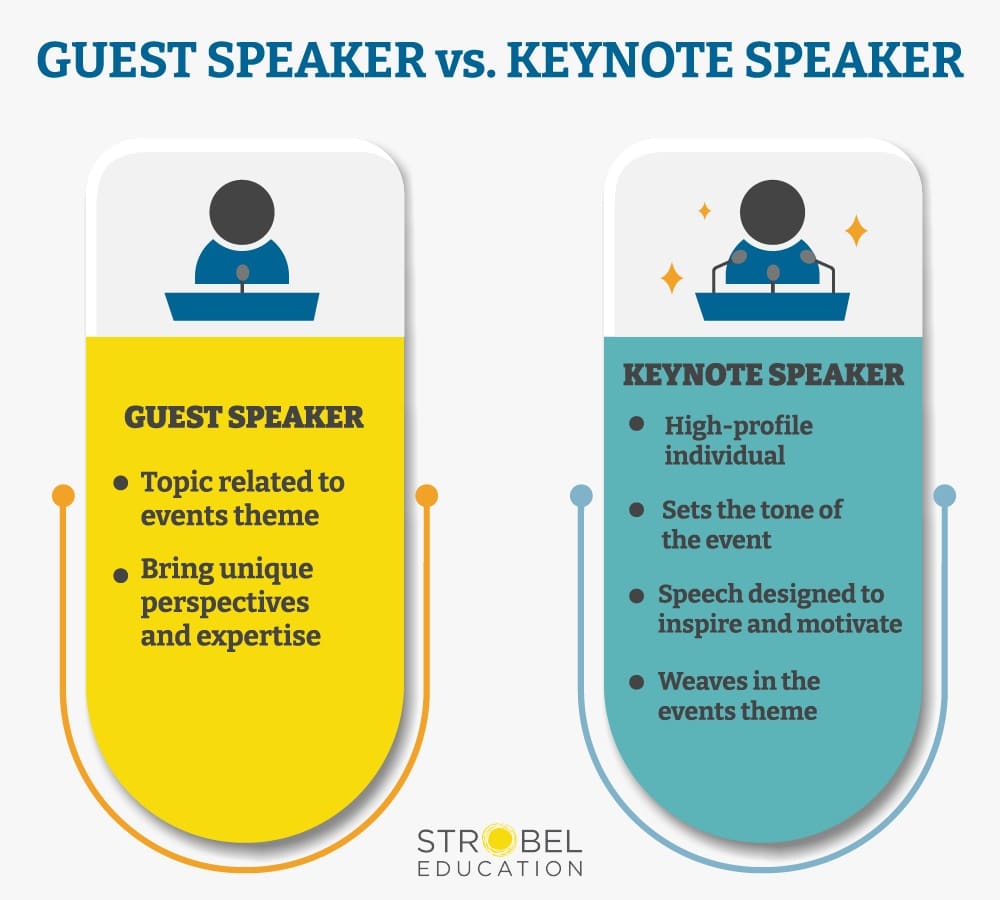
Image source: Strobel Education
How to Structure a Keynote Address Using the Throughline Methodology
Writing a keynote is a significant undertaking that requires more than just a collection of anecdotes. Successful speakers often use a "Throughline"—a consistent narrative thread that connects every story, data point, and joke back to the core message. Without a throughline, a speech feels like a series of disconnected segments; with one, it feels like a cohesive journey.
The "4-Word Rule"
A concept popularized by legendary communicators like Steve Jobs is the 4-Word Rule. If you cannot summarize the core message of your keynote in four words or fewer, the message is likely too complex for the audience to retain. For example, a keynote on innovation might have the throughline: "Embrace discomfort, spark change." This simplicity allows the audience to carry the "key note" with them throughout the event.
The Rule of Three
Human memory is naturally optimized for groups of three. Whether it is "Life, Liberty, and the Pursuit of Happiness" or "Location, Location, Location," the Rule of Three is a top-tier tool for speechwriters. A well-structured keynote often breaks its throughline into three distinct pillars or stories. This makes the content digestible and provides a clear roadmap for the listener.
The Ideal Workflow for Speech Creation
- Identify the "Primary Interest" of the specific audience.
- Distill the core message into a 4-word throughline.
- Select three anchor stories that illustrate the throughline.
- Remove any data or slides that do not directly support the narrative thread.
- Draft a "Speech of Introduction" to be read by the emcee to set the stage.
- Rehearse for a 45-minute delivery to ensure maximum impact.
Professional Logistics and the Economics of the Speaking Industry
Behind every 45-minute keynote is a complex web of logistics and economics. For event organizers, hiring a keynote speaker involves more than just a fee; it involves understanding the standards of the professional speaking industry.
Speaker Bureau Economics
Many high-level keynote speakers are represented by bureaus. These organizations typically take a commission of 25% to 30% of the speaker's fee. This commission is usually "inclusive," meaning the speaker pays the bureau out of their total fee, keeping the cost transparent for the client. Understanding this structure helps organizers realize that the fee covers not just the time on stage, but the years of expertise and the administrative support required to get the speaker there.
CPE and Academic Credits
In professional fields like accounting, law, or medicine, keynote addresses often qualify for Continuing Professional Education (CPE) credits. This adds a layer of logistical requirements, such as mandatory sign-in/out sheets and specific learning objectives that must be met during the talk. As noted in real-world examples from the PCAOB, speakers in these settings often include legal disclaimers stating that their views are personal and do not necessarily represent their parent organizations.
The Importance of the "Speech of Introduction"
A keynote speaker's success often begins before they even say a word. The "Speech of Introduction" is a critical component that establishes the speaker's authority and builds anticipation. A poor introduction can leave the speaker digging out of a hole, while a strong one creates an immediate bond between the speaker and the audience. Organizers should always provide the emcee with a pre-written, 60-second introduction that highlights the speaker's relevance to the event's theme.
The Bottom Line
A keynote address is the heartbeat of a professional event, providing the essential "pitch" that aligns every attendee with a singular vision. To ensure your next keynote is a success, keep these key takeaways in mind:
- Theme-Setting: A keynote's primary job is to establish the "underlying theme" and framework for the entire event.
- Logistical Distinction: Remember that "plenary" describes the audience size, while "keynote" describes the content's purpose.
- Wisdom Over Data: The best keynotes are a distillation of wisdom that can stand alone without the aid of technology.
- The Throughline: Use a consistent narrative thread and the "4-Word Rule" to make your message memorable.
- Strategic Timing: Choose your placement (Opening, Mid, or Closing) based on the psychological needs of your audience.
- Professional Standards: Account for industry norms like speaker commissions, CPE requirements, and the critical "Speech of Introduction."
Before your next event, review your speaker's throughline to ensure it resonates with your audience's primary interests.