What Is a Content Roadmap and How Does It Drive Marketing Success?
A content roadmap is a high-level strategic document that visualizes how your content initiatives align with long-term business goals. Unlike a calendar, which focuses on daily tasks and deadlines, a roadmap acts as a "strategic bridge" that connects your marketing vision to execution. It outlines major themes, target audience segments, and key milestones to ensure every piece of content serves a measurable purpose.
What Exactly Is a Content Roadmap?
In the modern marketing landscape, a content roadmap serves as the GPS for your brand's narrative. It is not merely a list of blog titles or a social media schedule; rather, it is a comprehensive visualization of your strategic intent. According to Brightspot, a content strategy roadmap is the tool that ensures your team isn't just producing content for the sake of activity, but is moving toward specific business objectives.
Think of the roadmap as the "route" you plan to take across a continent. It identifies the major cities you will visit (themes), the terrain you will navigate (channels), and the estimated time of arrival at your destination (milestones). Without this high-level view, marketing teams often fall into the trap of "random acts of content"—producing high-quality assets that fail to move the needle because they lack a cohesive direction.
The visual nature of a roadmap is one of its most critical features. While a spreadsheet can list data, a visual roadmap allows stakeholders to see the flow of work over time. This clarity helps in identifying overlaps, gaps in the buyer journey, and periods of high resource demand. By treating the roadmap as a living document, teams can remain agile, adjusting their path as market conditions or business priorities shift.
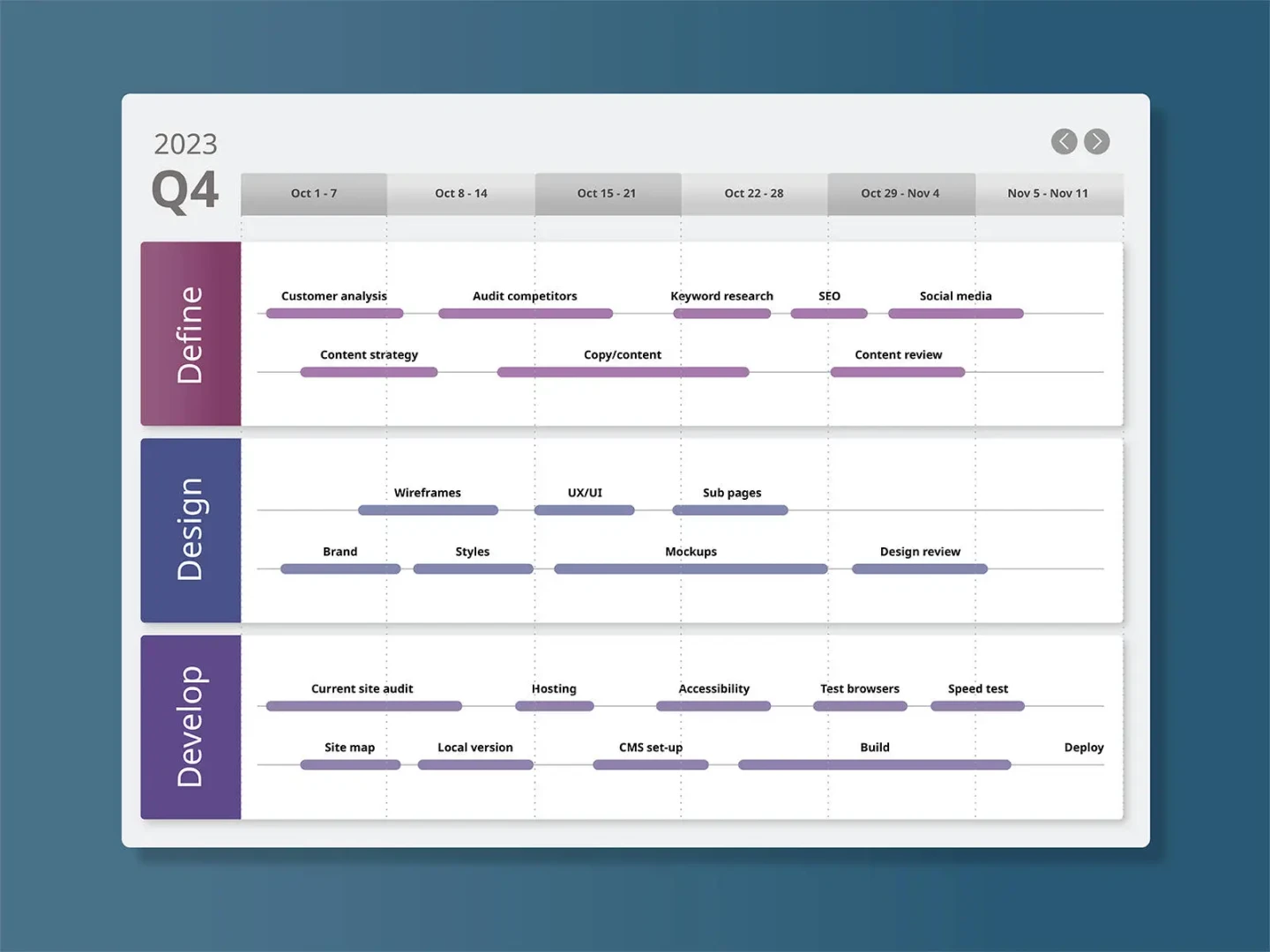
Image source: Brightspot
Content Roadmap vs. Content Calendar — What Is the Difference?
One of the most common points of confusion in marketing departments is the distinction between a roadmap and a calendar. While they are complementary, they serve entirely different functions. A roadmap is strategic, focusing on the "why" and "what," whereas a calendar is tactical, focusing on the "when" and "who."
A content calendar is a granular schedule. It tells you that a specific blog post needs to be published on Tuesday at 10:00 AM and that Sarah is responsible for the final edit. It is essential for maintaining consistency and managing the daily grind of production. However, a calendar rarely explains how that specific blog post contributes to a 20% increase in lead generation for the quarter. That is the job of the roadmap.
| Feature | Content Roadmap | Content Calendar |
|---|---|---|
| Scope | Quarterly or Yearly (High-level) | Weekly or Monthly (Granular) |
| Primary Goal | Strategic Alignment & ROI | Publishing Consistency & Execution |
| Ownership | Strategists & Stakeholders | Creators & Editors |
| Timeline | Themes and Milestones | Specific Headlines and Dates |
As noted by CoSchedule, you need both to be successful. A roadmap without a calendar is a dream that never gets executed, while a calendar without a roadmap is just "busywork" that lacks a clear destination. The roadmap sets the stage, and the calendar manages the performance.
Why Your Marketing Strategy Needs a Visual Roadmap
Visual roadmaps are notably effective at preventing "reactive marketing." In many organizations, the content team is treated as a service department, fielding last-minute requests from sales, product, or executive teams. Without a roadmap, it is difficult to say "no" or "not now" because there is no visible plan to point to. A roadmap provides the evidence needed to show that a new, unplanned request will displace a high-priority strategic initiative.
Furthermore, visual workspaces—such as those provided by Mural—allow for better stakeholder buy-in. When stakeholders can see the roadmap as a series of "distinct objects" rather than lines in a spreadsheet, they can participate in the prioritization process. They can "vote" on which themes are most important, leading to a sense of shared ownership over the marketing outcomes.
Milestones within a roadmap also serve as vital signposts for team morale. In the long slog of content production, it is easy for teams to feel burnt out. By defining milestones—such as the completion of a major white paper series or reaching a traffic goal—you create natural checkpoints to celebrate wins. This keeps the team focused on the "big picture" rather than just the next deadline.
How to Build a Strategic Content Roadmap from Scratch
Building a roadmap requires a disciplined approach that starts long before you open a CMS or a design tool. It is a multi-step process that ensures your content is grounded in reality and business needs.
Step 1: Set SMART Goals
Every roadmap must begin with clear objectives. These should be Specific, Measurable, Achievable, Relevant, and Time-bound. For example, instead of saying "we want more traffic," a SMART goal would be "increase organic traffic to the product landing pages by 15% by the end of Q3." This gives your roadmap a target to aim for.
Step 2: Define the Audience & Funnel Stages
Content must be mapped to the buyer's journey. A balanced roadmap includes content for the Awareness stage (educational blogs), the Consideration stage (comparison guides), and the Decision stage (case studies and demos). If your roadmap is heavily weighted toward one stage, you will likely see a bottleneck in your conversion funnel.
Step 3: The Content Audit
Before creating new assets, evaluate what you already have. A content audit identifies high-performing pieces that can be repurposed and low-performing pieces that should be updated or deleted. This prevents the waste of resources on topics you have already covered extensively.
Step 4: Identify Gaps and Opportunities
Using keyword research and customer feedback, look for the "missing links" in your current strategy. What questions are customers asking that you haven't answered? What topics are your competitors ignoring? These gaps represent your greatest opportunities for differentiation.
Step 5: Choose Channels and Content Types
Not all content belongs on a blog. Your roadmap should specify which channels (email, social, video, webinars) are best suited for each theme based on where your audience spends their time. As Airfocus suggests, this phase is about matching the medium to the message.
Step 6: Establish Measurement Frameworks
Finally, decide how you will track success. Move beyond "vanity metrics" like page views and focus on "impact metrics" like lead quality, conversion rates, and customer retention. Your roadmap should include periodic reviews to analyze these metrics and adjust the plan accordingly.
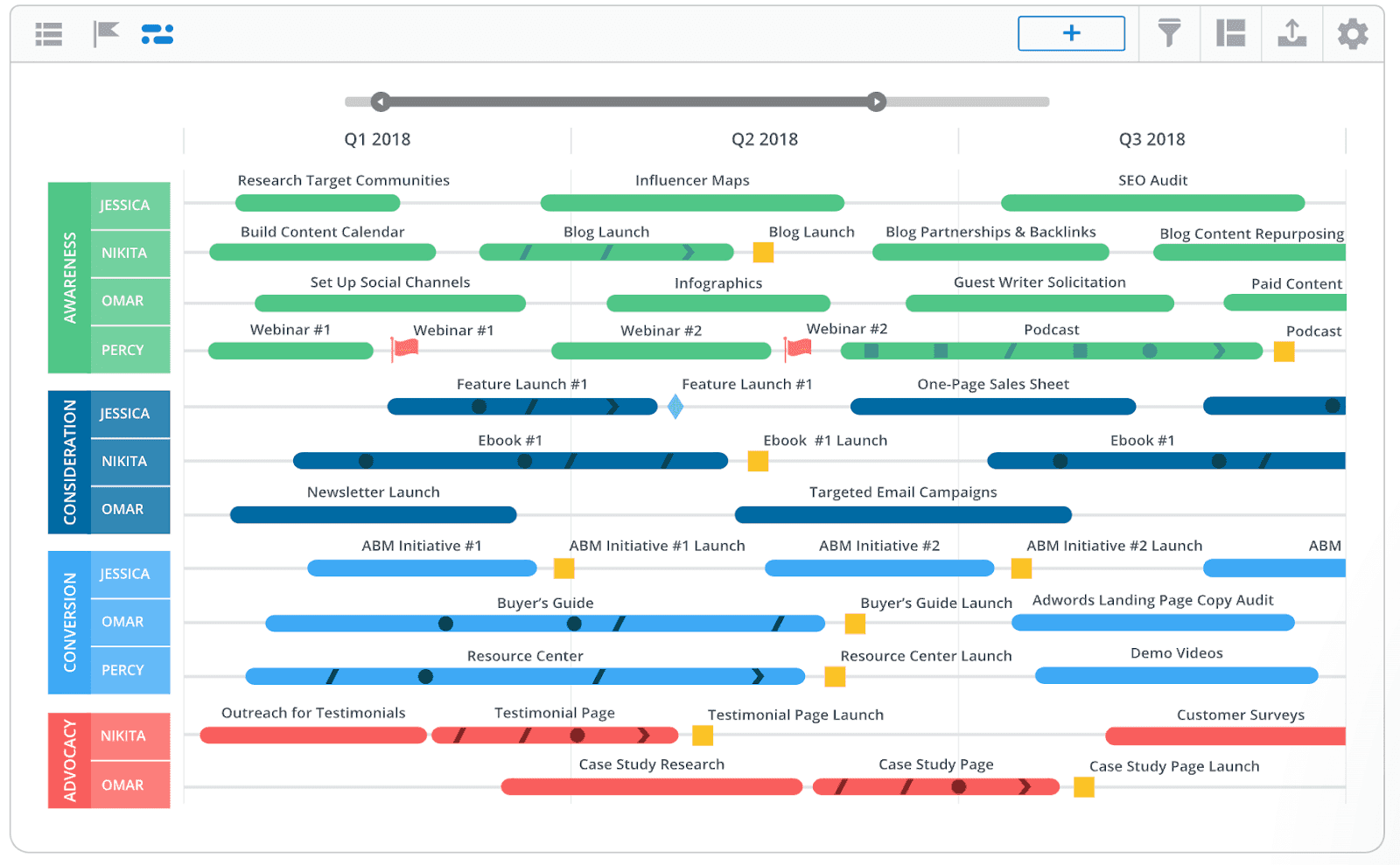
Image source: CoSchedule
Treating Your Content Like a Product to Solve Real Problems
A notably innovative approach to roadmapping is the "Content as a Product" framework. In this mindset, you don't just "fill a calendar"; you build a solution for a user's problem, just as a software engineer builds a feature. According to the MKT1 Newsletter, this shift in perspective is crucial for B2B companies looking to stand out in a crowded market.
One way to implement this is through Perception Ladders. Instead of brainstorming random topics, identify 3-4 core brand perceptions you want to own. For example, if you want to be perceived as the "most secure" option in your industry, every item on your roadmap should ladder up to that perception. This ensures a unified brand voice across all channels.
Mapping Cross-Functional Dependencies Before You Start Writing
A common pitfall in content planning is working in a vacuum. A high-value roadmap accounts for the "Information Gathering" phase, where marketing needs data from Sales, Product Development, and even Accounting before the creative process begins. This ensures that the content is factually accurate and aligned with the latest product updates.
Furthermore, roadmaps must synchronize with Go-To-Market (GTM) cycles. If the product team is launching a new feature in October, the content roadmap must reflect the build-up of awareness in August and September. This synchronization prevents the "silo effect" where marketing is talking about one thing while the rest of the company is focused on another.
Using Gantt-style views can also highlight "handoff dependencies." For instance, the design team cannot start on an infographic until the copy is finalized. By visualizing these dependencies, you can identify potential bottlenecks before they delay your entire schedule. This level of planning is what separates professional operations from amateur ones.
How to Align Your Roadmap With Technical CMS Constraints
A roadmap that ignores technical reality is destined for failure. Your content strategy must account for what your Content Management System (CMS)—whether it's WordPress, Drupal, or a headless solution—can actually do. As discussed by Forum One, technical debt can significantly hinder your ability to execute a roadmap.
If your roadmap calls for a highly interactive, data-driven comparison tool, but your CMS doesn't support custom data structures, you will face a "maintenance headache." You must decide whether to build a manual workaround (which adds to technical debt) or to wait for a CMS upgrade. A "CMS-aware" roadmap includes these technical requirements as part of the planning process.
By choosing "Core" features over "Custom" workarounds whenever possible, you allow your content strategy to scale much faster. The roadmap should be a collaborative effort between the content team and the web development team to ensure that the vision is technically feasible.
Should Your Company Use a Public Content Roadmap?
In recent years, some B2B companies have experimented with public roadmaps, showing their customers exactly what content and features are coming next. The primary argument for this is transparency. It builds trust and allows users to plan their own workflows around your upcoming releases.
However, there is a risk of becoming a "dinosaur." As noted in the Asana Community, public roadmaps can sometimes force a company to become reactive, building only what users ask for rather than innovating. It can also tip off competitors to your strategic direction.
- The Transparency Argument
- Public roadmaps build brand loyalty and reduce the volume of "when will you cover X?" support tickets.
- The Strategic Risk
- Public roadmaps can limit your agility, making it harder to pivot when market conditions change without disappointing your audience.
Frequently Asked Questions
How often should I update my content roadmap?
A content roadmap should be a living document. Most successful teams perform a "deep dive" review once per quarter to align with major business goals. However, you should also perform "light adjustments" monthly to stay agile. If a major market shift occurs or a new product feature is fast-tracked, the roadmap must be updated immediately to reflect the new priorities.
What tools are best for content roadmapping?
The "best" tool depends on your team's size and needs. For visual collaboration and brainstorming, tools like Mural or Miro are excellent. For project management and dependency tracking, Asana, Airtable, or Notion are top choices. The key is to choose a tool that allows for a high-level "timeline" view rather than just a list of tasks.
How do I handle a sudden change in business goals?
When business goals shift, you must re-evaluate your roadmap against the new SMART goals. Identify which current initiatives still align with the new direction and which should be paused. This is where the "Impact vs. Effort" scoring becomes invaluable—it helps you objectively decide which new ideas deserve a spot on the revised roadmap.
Who should own the content roadmap?
Typically, the Content Strategist or Marketing Manager owns the roadmap. However, it should not be created in isolation. It requires input from stakeholders in Sales, Product, and Customer Success to ensure that the content being planned actually solves the problems the rest of the company is facing.
Can a small business use a content roadmap?
Absolutely. In fact, a roadmap is perhaps even more critical for small businesses with limited resources. It prevents you from wasting time and money on low-impact content. A simple roadmap can be created in a Google Sheet or a basic Trello board, as long as it focuses on strategic alignment rather than just a list of dates.
The Bottom Line
A content roadmap is the essential link between your marketing aspirations and your daily output. By moving beyond the simple calendar and embracing a strategic, visual, and cross-functional approach, you ensure that every asset you create contributes to the bottom line.
- Strategic Bridge: A roadmap is a high-level guide, not a tactical task list.
- Funnel Alignment: Ensure your content covers every stage from Awareness to Decision.
- Content as a Product: Treat your content as a solution to specific user problems.
- CMS Awareness: Account for technical constraints to avoid execution bottlenecks.
- Cross-Functional Unity: Synchronize with Sales and Product teams for a unified brand message.
- Visual Clarity: Use visual tools to gain stakeholder buy-in and manage dependencies.
- Agile Maintenance: Review and adjust your roadmap quarterly to stay relevant.
To begin, audit your existing assets today and identify the three core brand perceptions you want your audience to hold by the end of the year.