How to Write an Amazon 6-Pager That Drives Better Strategic Decisions
A 6-pager is a six-page narrative memo used for high-stakes strategic decision-making. Originally developed at Amazon, it replaces slide decks with dense, full-sentence prose to force clear thinking. Meetings typically begin with a "Silent Start," where participants read the document for 20–30 minutes before discussing it. This method ensures everyone has equal context and prioritizes "truth-seeking" over "selling."
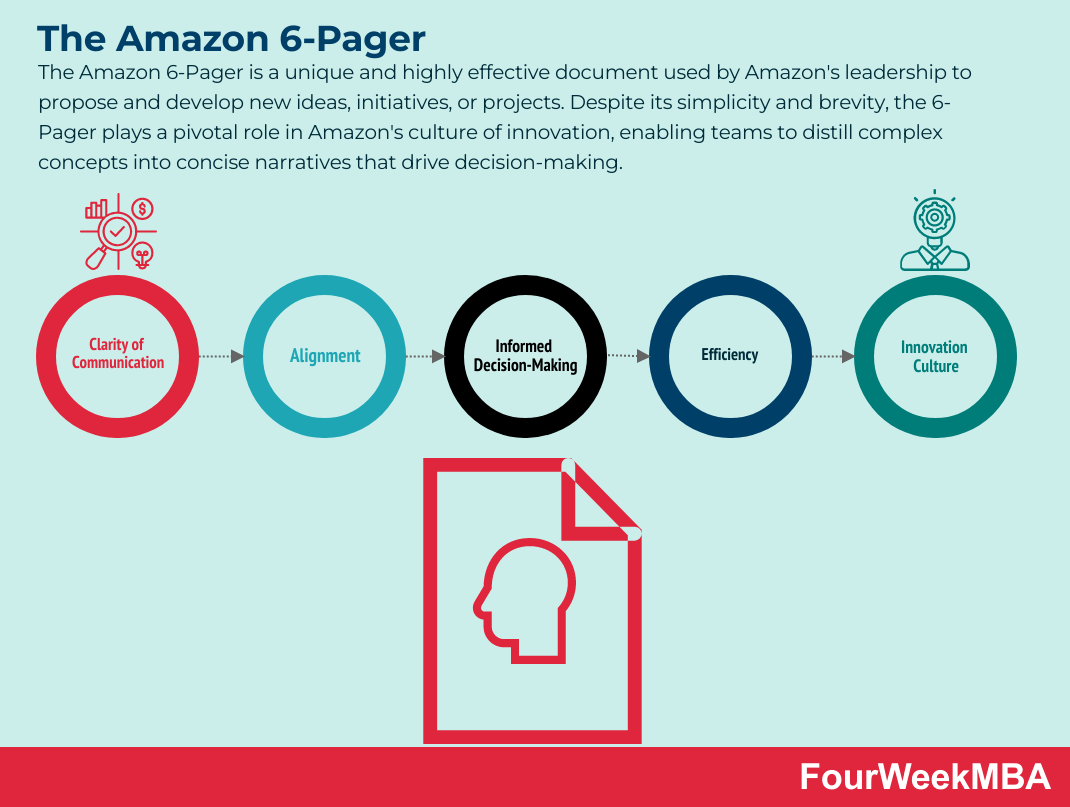
Image source: FourWeekMBA
Why Jeff Bezos Banned PowerPoint for Strategic Meetings
In 2004, Jeff Bezos sent a now-famous internal email to his senior leadership team, effectively banning PowerPoint presentations for all internal meetings. This shift was not merely a matter of aesthetic preference; it was a fundamental pivot in how information is processed at the highest levels of business. According to Larksuite, the move was designed to move away from the "sales" nature of slides and toward a "truth-seeking" culture.
The Cognitive Load of Narrative vs. Bullets
PowerPoint, by its nature, encourages the use of bullet points. While bullets are excellent for lists, they are often insufficient for expressing complex, interconnected ideas. Narrative prose requires the writer to use transitions, logical connectors, and full sentences, which forces a deeper level of cognitive processing. When you read a narrative, your brain must reconcile the relationship between different ideas, whereas bullet points allow the presenter to gloss over logical gaps with verbal hand-waving.
Truth-Seeking vs. Selling
In a slide-based culture, the presenter is often "selling" an idea. The goal is to persuade the audience through visual flair and charismatic delivery. In a narrative-based culture, the document must stand on its own. If the logic is flawed, the prose will reveal it. This makes the 6-pager one of the most effective tools for identifying risks before they become expensive failures. As noted by Visme, the 6-pager is widely regarded as a top choice for organizations that value data-driven rigor over presentation style.
The Core Philosophy of Narrative Based Decision Making
The underlying philosophy of the 6-pager is simple: Writing is thinking. If you cannot write a clear, six-page narrative about a project, you likely haven't fully thought through the problem. This methodology is used for massive decisions, including the $1.1 billion acquisition of Ring, ensuring that every angle is scrutinized before a single dollar is spent.
The "Rubber Duck" Effect in Writing
Many practitioners find that the act of writing the 6-pager often solves the problem before the meeting even happens. This is similar to the "Rubber Ducking" technique in software engineering, where explaining a problem out loud helps you find the solution. By the time an author reaches page four or five, they often identify a logical inconsistency or a missing data point that changes their entire recommendation. This self-correction mechanism is a significant advancement over traditional brainstorming sessions.
High-Stakes Accountability
Because the 6-pager is a permanent record of a decision, it creates a high level of accountability. Years later, a team can look back at a memo to see exactly what the assumptions were at the time of the decision. This allows for a "Lessons Learned" culture that is grounded in reality rather than hazy memories of a slide deck.
Standard Anatomy of a Professional Six Page Memo
While the content of a 6-pager varies depending on the topic, most follow a standard structure to ensure consistency and ease of reading for executives. According to the Writing Cooperative, a successful memo typically includes six essential sections.
1. Introduction
Defines the purpose of the memo, the problem being solved, and the "Why" behind the proposal. It sets the stage for the entire narrative.
2. Goals
What does success look like? This is the one section where bullet points are often acceptable to list specific, measurable metrics.
3. Tenets
The guiding principles for the project. These are the "rules of the road" that help the team make trade-offs when conflicts arise.
4. State of the Business
Current context and data. This section provides the baseline from which the proposal is built, including market trends and internal performance.
5. Lessons Learned
A transparent look at what has been tried before, what failed, and what the data says about those previous attempts.
6. Strategic Priorities
The proposed path forward. This is the "What" and the "So What" of the document, detailing the specific actions recommended.
Recommended Page Ratios
To maintain balance, expert writers often follow specific page-count targets. While these aren't hard rules, they help prevent "bloat" in the wrong areas:
- Introduction & Goals: 1 page.
- Tenets & State of the Business: 2 pages.
- Lessons Learned & Data Analysis: 1.5 pages.
- Strategic Priorities & Conclusion: 1.5 pages.
Strict Formatting Rules for Information Density
The 6-pager is designed for high information density. To achieve this, there are strict formatting rules that must be followed. If a document is too long, it is rejected; if it is too short, it may lack the necessary depth.
The 10-Point Font Standard
Internal Amazon memos typically use a 10-point font (often Arial or Times New Roman) with minimal margins. This allows for approximately 500–600 words per page. The goal is not to make the text unreadable, but to maximize the amount of context an executive can absorb in a single sitting. When every word must earn its place on the page, the quality of the writing naturally improves.
Narrative Prose Only
With the exception of the "Goals" section, the document should be written in full-sentence, narrative prose. This prevents the "PowerPoint effect" where readers fill in the blanks with their own assumptions. Every claim must be supported by a "because" or "as evidenced by."
Advanced Writing Techniques for Executive Memos
Writing a 6-pager is an exercise in discipline. To reach the level of clarity required for executive decision-making, you must move beyond basic reporting and into strategic synthesis.
The "Why/What" vs. "How" Rule
A common mistake is spending too much time on the How (technical implementation) and not enough on the Why (strategic rationale) and What (the specific proposal). Executives are primarily concerned with the strategic alignment and the expected outcome. If they need to understand the technical details, they will look at the appendix. Keep the core 6 pages focused on the high-level logic. As Auditless suggests, the 6-pager is the "minimum dose of strategy" needed for high-speed companies.
Banishing "Strategy Speak"
Avoid buzzwords like "flywheels," "moats," or "synergies" unless they are backed by specific, quantifiable data within the text. If you claim a new feature will create a "flywheel effect," you must explain exactly how one action leads to another and provide the data that supports that causal link. Vague language is the enemy of a good 6-pager.
Running the Silent Start Meeting in Remote Environments
The "Silent Start" is perhaps the most famous aspect of the 6-pager culture. Instead of a presentation, the first 20–30 minutes of the meeting are spent in total silence while everyone reads the memo. This ensures that everyone—regardless of how busy they were before the meeting—has the exact same context.
Adapting for Remote and Hybrid Teams
In a remote setting (Zoom, Teams, or Slack), the silent start requires a bit more coordination to maintain focus:
- Shared Digital Workspaces: Use tools like Google Docs or Notion in "Comment Only" mode. This allows participants to leave questions and feedback in the margins without disrupting the author's text.
- On-Screen Timers: The meeting lead should share their screen with a countdown timer. This provides a visual cue for when the reading period will end.
- The "Camera On" Rule: To maintain the "shared presence" of a physical meeting, participants are encouraged to keep their cameras on during the reading period. This discourages multitasking or checking emails.
The Iterative Workflow for High Impact Writing
A high-quality 6-pager is rarely written in a single sitting. It is the result of a rigorous, iterative process. While a 50-slide PowerPoint might take 5 days to produce, a 6-pager often takes 10 days or more because the level of thinking required is so much higher.
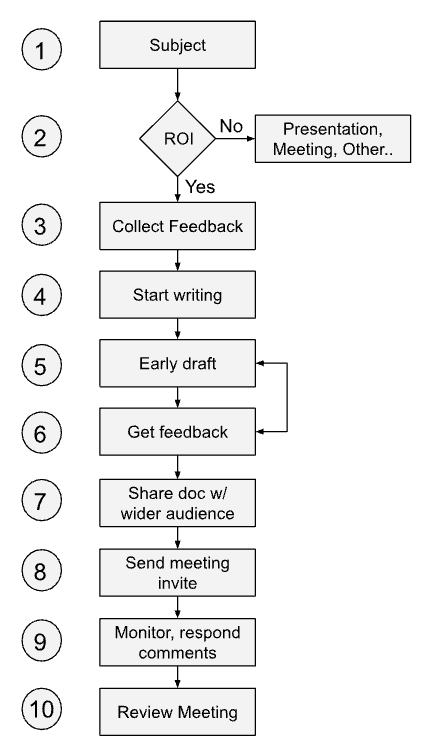
Image source: Six Pager Memo
The Pre-Meeting Loop
- The Solo Draft: Get your thoughts onto paper without worrying about the page limit initially. Focus on the logical flow.
- The Peer Review: Share the draft with 1–2 trusted colleagues. Ask them to "red-team" your logic and find the holes in your argument.
- The Data Audit: Ensure every claim in your narrative is backed by a chart or data point in the appendix. If you say "customers prefer X," you must have the survey data to prove it.
- The Final Polish: This is where you cut the filler. If a sentence doesn't add new information or strengthen the logic, delete it.
Comparing the 6-Pager to Other Communication Tools
Not every meeting requires a 6-pager. Choosing the right tool for the job is essential for maintaining organizational velocity. Use the following framework to decide which document type fits your current needs.
| Document Type | Best Used For | Primary Audience | Key Constraint |
|---|---|---|---|
| 1-Pager | Status updates, simple project approvals, or quick pitches. | Immediate team or direct manager. | Strict 1-page limit; high-level summary. |
| 6-Pager | Strategic shifts, new product launches, M&A, and annual planning. | Executives and cross-functional stakeholders. | 6 pages of narrative prose; dense data. |
| PowerPoint | External sales, keynote speeches, and inspirational "all-hands." | Large audiences or external clients. | Visual-heavy; low information density. |
Frequently Asked Questions
Can I use images or charts inside the 6 pages? +
Yes, but you should use them sparingly. Only include a chart or image within the core 6 pages if it is absolutely essential to the narrative flow and cannot be understood through text alone. If the chart requires extensive explanation, it is often better to summarize the key takeaway in the prose and move the full visual to the appendix.
What happens if my narrative is only 4 pages? +
That is perfectly acceptable. The 6-page rule is a maximum limit, not a minimum requirement. Brevity is highly valued in strategic writing. If you can make a compelling, data-backed argument in four pages, your audience will appreciate the time saved. Never "fluff" a document just to reach the six-page mark.
Is the 6-pager used for every meeting at Amazon? +
No. The 6-pager is typically reserved for significant strategic decisions, "Working Backwards" product documents (PR/FAQs), and quarterly or annual business reviews. Routine tactical meetings or quick syncs usually rely on 1-pagers or simple dashboard reviews to maintain speed.
How do I handle comments during the silent reading period? +
In physical meetings, participants usually take notes on a printed copy of the memo. In remote settings, using "Comment Only" mode in a shared document is a top-tier approach. This allows the author to see all questions at once and group them by topic during the discussion phase, making the Q&A much more efficient.
What is the best font to use for a 6-pager? +
Standard practice is to use a highly readable serif or sans-serif font at 10-point size. Arial, Calibri, or Times New Roman are common choices. The goal is to ensure the text is clear and professional, allowing the reader to focus entirely on the logic of the narrative rather than the typography.
Key Takeaways for Writing a High-Impact 6-Pager
- Prioritize Narrative Over Bullets: Use full sentences to force logical connections and identify gaps in your thinking.
- Respect the 6-Page Limit: Keep your core argument concise and move all supporting data to an unlimited appendix.
- Focus on the Why and What: Ensure executive audiences understand the strategic rationale before diving into the implementation.
- Implement the Silent Start: Dedicate the first 20–30 minutes of every meeting to quiet reading to ensure equal context.
- Iterate Through Peer Review: Use a "pre-meeting loop" to stress-test your logic with colleagues before the official review.
- Ban Strategy Buzzwords: Replace vague terms with specific, quantifiable data points that support your claims.
To start improving your team's decision-making today, try replacing your next strategic slide deck with a three-page narrative memo and observe how the quality of the discussion changes.