
How to Master Problem Solving and Use the Correct Grammar Every Time
The rule for hyphenating this term depends entirely on its grammatical function in your sentence:
- Use a hyphen (Problem-solving) when it acts as a compound adjective modifying a noun. Example: "She has excellent problem-solving skills."
- Do not use a hyphen (Problem solving) when it acts as a standalone noun phrase. Example: "He is an expert in problem solving."
Whether you are drafting a resume, writing a corporate performance review, or simply trying to navigate a complex operational bottleneck, the distinction between "problem solving" and "problem-solving" frequently causes hesitation. While the grammatical rule is straightforward, the actual application of the skill is anything but simple.
Organizations that excel at identifying and resolving friction points are highly competitive, with some data suggesting they grow income significantly faster than their peers. Yet, many professionals struggle because they treat problem resolution as a routine checklist rather than a dynamic, analytical mindset.
This article will clarify the grammatical rules to ensure your professional writing is flawless, and then provide a comprehensive, modern framework to elevate your analytical capabilities—including how to avoid common cognitive traps and leverage artificial intelligence in your workflow.
When Should You Hyphenate Problem-Solving?
The confusion surrounding the hyphenation of this term stems from the rules governing compound modifiers in the English language. According to major style guides, including Merriam-Webster, the presence of a hyphen is dictated by the word's placement and function relative to the noun it describes.
The Adjective Rule
When you use the phrase to describe another word—acting as a compound adjective—you must hyphenate it. The hyphen links the two words together so the reader understands they function as a single descriptive unit modifying the noun that follows.
- Correct: We need to hire someone with strong problem-solving abilities.
- Correct: The team scheduled a problem-solving workshop for Tuesday.
- Correct: Her problem-solving methodology is highly effective.
The Noun Rule
When the phrase stands alone as the subject or object of a sentence—acting as a noun—you drop the hyphen. In this case, "solving" is a gerund (a verb acting as a noun), and "problem" tells us what is being solved.
- Correct: Problem solving is a critical competency for modern managers.
- Correct: He dedicated his career to the study of complex problem solving.
- Correct: The curriculum focuses heavily on collaborative problem solving.
Why This Matters for Your Career: Applicant Tracking Systems (ATS) used by human resources departments are generally programmed to recognize both variations. However, hiring managers and executive readers often notice grammatical precision. Using the hyphen incorrectly on a resume (e.g., listing "Expert in problem-solving" instead of "Expert in problem solving") can subtly undermine a candidate's attention to detail.
What Exactly Is a Problem and Why Does It Matter?
Before attempting to resolve an issue, it is necessary to define what a "problem" actually is in a professional context. In organizational psychology and continuous improvement methodologies, a problem is strictly defined as the gap between your current condition and your desired future state.
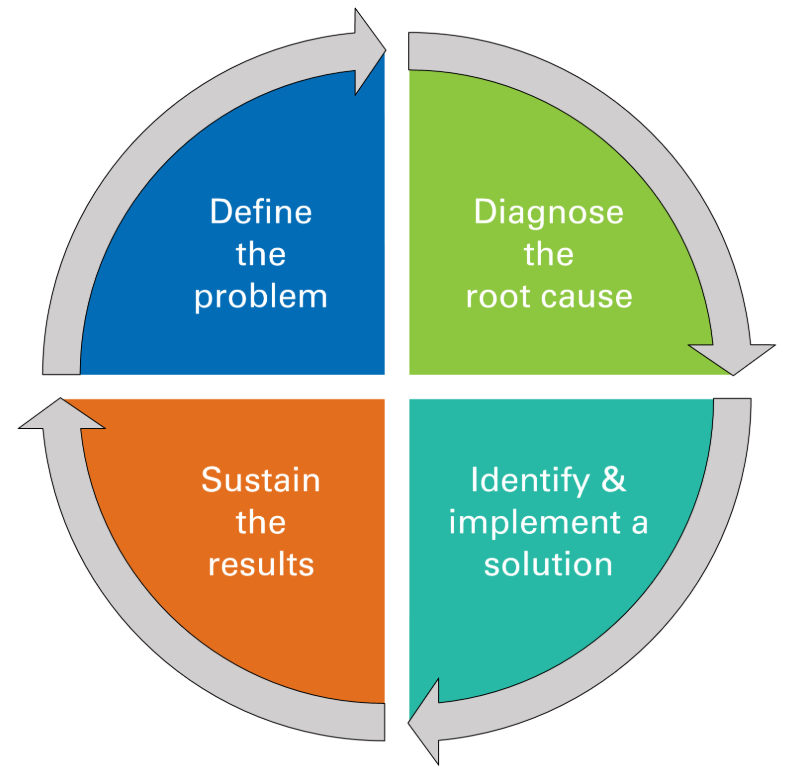
Image source: ASQ
According to the American Society for Quality (ASQ), recognizing this gap is the foundational step of any improvement initiative. If you cannot clearly articulate the current state and the target state, you do not have a definable problem; you merely have a vague sense of dissatisfaction.
The ROI of Mastery
Developing a structured approach to closing these gaps yields measurable returns. Research highlighted by facilitation experts at SessionLab indicates that organizations proficient in these methodologies are 3.5 times more likely to grow their income faster than competitors. This is because effective resolution prevents the recurrence of costly errors, reduces operational waste, and fosters an environment of continuous innovation.
Cognitive Load and Higher-Order Thinking
It is important to distinguish between routine tasks and actual problem resolution. Routine tasks rely on automated cognitive processes—you encounter a familiar situation and apply a known response. True problem resolution is a "higher-order cognitive process." It requires the active modulation of fundamental skills (like memory, attention, and logic) to navigate an obstacle where the path forward is currently unknown.
A Master 7-Step Framework for Effective Problem Solving
Academic institutions and corporate training programs offer various models, ranging from four-step cycles to complex eight-step methodologies. However, synthesizing these approaches reveals a consistent, logical progression. The following 7-step master framework integrates the most critical elements from lean management, Six Sigma, and cognitive psychology.
The most critical step is articulating the friction point objectively. State what is happening versus what should be happening. Avoid embedding a proposed fix into the definition (e.g., say "Customer wait times exceed 10 minutes," not "We need more customer service reps").
Borrowed from lean manufacturing, "Gemba" means "the real place." Do not rely solely on reports or dashboard metrics. Go to the physical or digital location where the work happens. Observe the "as-is" process directly to gather unfiltered data about the current condition.
Once the gap is defined and observed, investigate the underlying cause. A common pitfall is treating the symptom rather than the disease. Use structured questioning to drill down past surface-level issues until you find the systemic failure point.
Resist the urge to run with the first idea that sounds plausible. Cognitive bias often makes our first few ideas the most conventional and least effective. Force the team to generate at least 20 potential solutions. The first five will be obvious, the next ten will be difficult, and the final five often contain highly innovative approaches.
Evaluate the generated ideas using a decision matrix. Plot each potential solution against two axes: Impact (how completely it closes the gap) and Feasibility (cost, time, and resources required). Select the option that offers a strong balance of high impact and realistic implementation.
A solution is only a hypothesis until it is implemented. Develop a clear action plan that assigns specific ownership and strict deadlines to every task. Ambiguity in execution is a primary reason why good ideas fail in the real world.
After implementation, measure the new current state against the original desired state. Did the gap close? If yes, standardize the new process, update training materials, and share the findings across the organization to prevent regression.
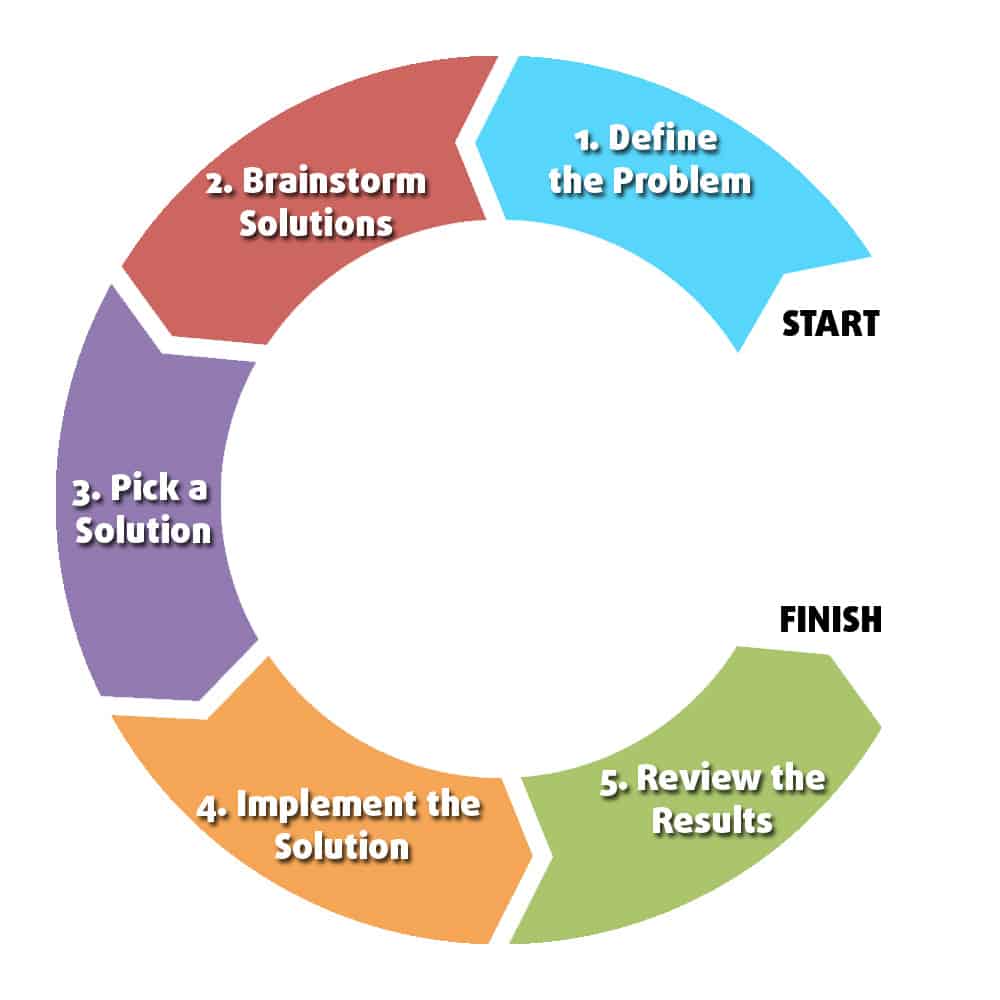
Image source: Humor That Works
Communication Tip: "Why" vs. "What"
When conducting Root Cause Analysis (Step 3), be mindful of your language. Using the "5 Whys" technique is excellent for analyzing machines, software, and processes. However, when questioning human behavior, asking "Why did you do that?" often triggers defensiveness. Instead, use "What" or "How" questions: "What factors led to this decision?" or "How did the process break down here?" This maintains psychological safety while uncovering the same information.
How to Avoid the Solution Trap When Defining Problems
One of the most frequent reasons initiatives fail is that teams fall into the "Solution Trap." As highlighted in a Harvard Business School presentation, when professionals are asked to define a problem, they almost instinctively describe a missing solution.
For example, a marketing director might state: "Our problem is that we don't have an enterprise-grade CRM."
This is not a problem; it is a demand for a specific tool. By framing the issue this way, the director has prematurely closed off all other avenues of inquiry. The actual problem might be: "We are losing track of 30% of our inbound leads before the second follow-up."
If the team focuses on the real problem (lost leads), they might realize that a simple adjustment to their existing lead-routing workflow solves the issue entirely, saving the company thousands of dollars on unnecessary CRM software.
The "Problem vs. Solution" Audit Checklist
Before moving past Step 1 of the framework, run your problem statement through this audit:
- Does the statement contain a verb indicating lack? (e.g., "We need," "We lack," "We don't have"). If so, you are likely naming a missing solution.
- Can the statement be solved in exactly one way? If the only logical answer to your statement is "buy X" or "build Y," it is too narrow.
- Does it describe the friction experienced by the user/customer? A strong statement focuses on the pain point (e.g., "Customers cannot find pricing information easily"), not the internal mechanism.
Is Your Problem Simple, Complicated, Complex, or Wicked?
Applying a rigid, linear methodology to a highly volatile situation is a recipe for frustration. According to research published in the National Center for Biotechnology Information (PMC), issues exist on a spectrum of complexity. Understanding where your current challenge falls dictates the approach you should take.
| Problem Type | Characteristics | Recommended Approach |
|---|---|---|
| Simple | Single issue, clear cause-and-effect, predictable outcomes. (e.g., A broken printer). | Linear: Apply standard operating procedures. Find the broken part and replace it. |
| Complicated | Multiple moving parts requiring expert analysis, but remains predictable. (e.g., Designing a corporate dental plan). | Analytical: Bring in subject matter experts. Use structured frameworks and heavy data analysis. |
| Complex | Dynamic variables that interact unpredictably. The environment changes as you try to solve it. (e.g., Shifting market trends). | Iterative: Probe, sense, and respond. Run small, safe-to-fail experiments rather than massive rollouts. |
| Wicked | Social or cultural issues with contradictory, changing requirements. No clear stopping point. (e.g., Climate change, organizational culture toxicity). | Collaborative: Focus on mitigation and continuous management rather than seeking a permanent "cure." |
German psychologist Dietrich Dörner heavily criticized classical approaches for treating all issues as "Simple" or "Complicated." In Complex Problem Solving (CPS), variables are interconnected. Pulling one lever often causes unintended consequences elsewhere in the system. For complex scenarios, iterative testing is a highly effective way to proceed.
The Difference Between Solving Problems and Problem-Solving
While they sound identical, educators and cognitive scientists draw a sharp distinction between the act of "solving problems" and the broader competency of "problem-solving."
This occurs when you encounter a familiar obstacle and apply a known algorithm or procedure to overcome it. It relies heavily on memory and experience. For example, a mechanic fixing a specific engine knock they have seen a hundred times is "solving a problem." The path from current state to desired state is already mapped out; it just requires execution.
This is the cognitive process engaged when you do not know what to do. It requires intuition honing, navigating "corridors of inquiry," and managing the psychological frustration of dead ends. It is an exploratory mindset. A mechanic trying to diagnose a completely novel failure in an experimental electric vehicle is engaged in true "problem-solving."
Dr. Janine Brooks MBE notes that the failure of average leaders often stems from treating the latter like the former. When faced with a novel, complex situation, average leaders jump to the first familiar conclusion because ambiguity is uncomfortable. Top-tier problem solvers, conversely, are comfortable sitting in the ambiguity of the "unknown" while they gather data.
How to Use AI to Enhance Your Problem-Solving Process
Artificial Intelligence, specifically Large Language Models (LLMs), has introduced a new dynamic to analytical workflows. While AI should never replace human critical thinking or accountability, it serves as a remarkably capable collaborative partner when used correctly.
1. AI as a "Rubber Duck"
In software engineering, "rubber ducking" is the practice of explaining your code line-by-line to an inanimate object to spot logic errors. You can use an LLM for an advanced version of this. Prompt the AI: "I am going to explain my logic for solving [Issue]. Please do not provide a solution. Instead, point out any logical fallacies, unverified assumptions, or cognitive biases in my reasoning."
2. Generating the "20+ Ideas"
During Step 4 of the framework (Generating Solutions), human teams often hit a creative wall after 5 or 6 ideas. AI excels at divergent thinking. Feed your clearly defined problem statement into an LLM and prompt it to generate 30 distinct, unconventional, or even absurd solutions. While many will be unworkable, they often serve as creative springboards that help human teams break out of conventional thought patterns.
3. Simulating Stakeholder Pushback
Before finalizing your action plan (Step 6), use AI to stress-test your idea. Prompt the model: "Act as a skeptical Chief Financial Officer and a resistant frontline employee. Critique this proposed solution from both perspectives, highlighting potential risks, hidden costs, and implementation hurdles." This allows you to prepare mitigations before you ever pitch the idea to real stakeholders.
20 Powerful Techniques to Add to Your Toolkit
While the 7-step framework provides the overarching structure, specific techniques are required to execute the individual steps effectively. Here are several highly regarded tools used by continuous improvement professionals.
Image source: Innovation Training
The Fishbone (Ishikawa) Diagram
Used primarily in Step 3 (Root Cause Analysis), this visual tool helps teams map out potential causes of a specific event. The "head" of the fish represents the problem, and the "bones" represent major categories of potential causes—typically Equipment, Process, People, Materials, Environment, and Management. By brainstorming causes under each category, teams avoid focusing solely on human error and look at systemic issues.
Failure Mode and Effects Analysis (FMEA)
FMEA is a proactive technique used to anticipate where a proposed solution might break down. You list all potential failure modes of your new plan and score them on three criteria (usually on a scale of 1-10):
- Severity: How bad would the impact be?
- Occurrence: How likely is it to happen?
- Detection: How easily would we notice it before it causes harm?
Multiplying these three numbers gives you a Risk Priority Number (RPN). You then build safeguards into your action plan for the items with the highest RPNs.
Brainwriting
Traditional brainstorming often falls victim to the "loudest voice" bias, where extroverts dominate the session. Brainwriting solves this. Participants silently write down three ideas on a piece of paper, then pass the paper to the person next to them, who builds upon those ideas. This ensures equal participation and often yields deeper, more thoughtful concepts.
Reverse Brainstorming
When a team is stuck, flip the objective. Instead of asking, "How do we fix customer retention?" ask, "What could we do to guarantee every single customer cancels their subscription tomorrow?" Teams often find it easier to generate negative ideas. Once you have a list of ways to destroy retention, you reverse those concepts to find innovative ways to improve it.
Frequently Asked Questions
Is it problem solving or problem-solving?
It depends on how you use it in a sentence. Hyphenate it when it acts as an adjective modifying a noun (e.g., "problem-solving skills"). Do not hyphenate it when it acts as a standalone noun (e.g., "a course in problem solving").
What are the 5 main problem-solving skills?
While frameworks vary, the core competencies generally include: Analytical Thinking (breaking down complex data), Critical Thinking (evaluating validity without bias), Creativity (generating novel solutions), Decision Making (selecting the optimal path), and Communication (explaining the gap and the solution to stakeholders).
How do I show problem-solving skills on a resume?
Avoid simply listing "problem-solving" in a skills section. Instead, use the STAR method (Situation, Task, Action, Result) in your experience bullet points. Describe a specific gap you identified, the analytical action you took, and the quantifiable result (e.g., "Identified a supply chain bottleneck and implemented a new routing protocol, reducing delivery times by 15%").
What is the very first step in resolving an issue?
The first step is accurately defining the problem as a "gap" between the current state and the desired state, without embedding a presumed solution into the definition. If you misdiagnose the gap, every subsequent step will be wasted effort.
What are "Wicked Problems"?
Coined by design theorists Rittel and Webber, wicked problems are highly complex social or cultural issues (like poverty or climate change) that have incomplete, contradictory, and changing requirements. They cannot be permanently "solved" with a linear formula; they can only be managed and mitigated over time.
Final Thoughts
Mastering this competency requires moving beyond simple intuition and adopting a structured, analytical mindset. By understanding the grammar, avoiding cognitive traps, and applying the right framework to the right level of complexity, you position yourself as a highly effective professional capable of navigating ambiguity.
- Hyphenate the term only when it acts as an adjective modifying a noun.
- Define the gap objectively before you begin brainstorming any potential fixes.
- Audit your statements to ensure you haven't fallen into the "Solution Trap" by simply demanding a missing tool.
- Match your approach to the complexity of the issue—use linear methods for simple issues and iterative testing for complex ones.
- Leverage AI as a collaborative partner to stress-test your logic and generate divergent ideas.
- Use "What" and "How" questions instead of "Why" when investigating human behavior to maintain psychological safety.
