How to Create and Use a Professional Certificate of Completion for Any Industry
A certificate of completion is a formal document verifying that an individual has finished a specific course, training program, or project. Unlike professional certifications, which often require passing a standardized exam, these certificates focus on participation and attendance. They are widely used in corporate training, online learning, and the construction industry to provide a record of achievement. To maximize their value, recipients should pair them with "proof of work" projects on platforms like LinkedIn.
What Is a Certificate of Completion and What Does It Verify?
A certificate of completion serves as a formal record that an individual has successfully fulfilled the requirements of a specific educational or professional activity. According to Certfusion, this document verifies the successful finish of a course or training program, acting as a bridge between learning and professional recognition.
It is important to distinguish between participation and mastery. In most educational contexts, this document rewards attendance and the completion of assigned modules rather than the passing of a high-stakes, standardized exam. While it may not carry the same legal weight as a licensed certification in some fields, it remains a vital tool for tracking professional development and continuing education units (CEUs).
The significance of the document shifts depending on the industry. In the world of online learning (MOOCs), it is often a "nice-to-have" credential that signals a learner's commitment to self-improvement. However, in industries like construction, the document becomes a legal necessity. In that context, it signifies that a project has reached a stage of "substantial completion," triggering final payments and the commencement of warranty periods.
How Does a Certificate Differ from a Certification or Degree?
Understanding the educational hierarchy is essential for both students and employers. While the terms are often used interchangeably in casual conversation, they represent different levels of academic and professional rigor. Bellevue University notes that certificates are often more "flexible and accessible" than degrees, making them ideal for modern "skill-stacking."
| Criteria | Certificate of Completion | Professional Certification | University Degree |
|---|---|---|---|
| Requirement | Attendance & Participation | Standardized Exam & Experience | Multi-year Academic Study |
| Authority | Course Provider or Employer | Industry Board (e.g., PMI, AWS) | Accredited Institution |
| Duration | Hours to Weeks | Months of Prep | 2 to 4+ Years |
| Career Impact | Skill Verification | Professional Licensure | Foundational Credential |
For many professionals, certificates of completion are used to fill specific skill gaps. For instance, a software engineer might hold a Computer Science degree but earn various certificates in specific languages like Rust or Go to stay current. This approach allows for a dynamic resume that reflects up-to-the-minute expertise.
Download Free Certificate of Completion Templates for Word and PDF
Creating a professional-looking document does not require a graphic design degree. Several platforms offer top-tier templates that can be customized to fit your branding needs. When choosing a template, consider the delivery method: will it be printed on high-quality cardstock or sent as a digital PDF?
Top Template Platforms
- Canva: Ranks among the top choices for modern, visual-heavy designs with easy drag-and-drop editing.
- MS Word: A strong contender for simple, printable office use where text-based layouts are preferred.
- Adobe Express: Provides high-end professional branding options for those seeking a more polished aesthetic.
- Google Docs: Offers accessible, collaborative templates that are easy to share across teams.
Technical Specifications
For those planning to print their documents, adhere to these industry standards:
- Standard Size: 8.5 x 11 inches (US Letter) is the standard for most office printers.
- Color Models: Use CMYK for physical printing to ensure color accuracy; use RGB for digital-only versions.
- Resolution: Ensure images and logos are at least 300 DPI to avoid pixelation.
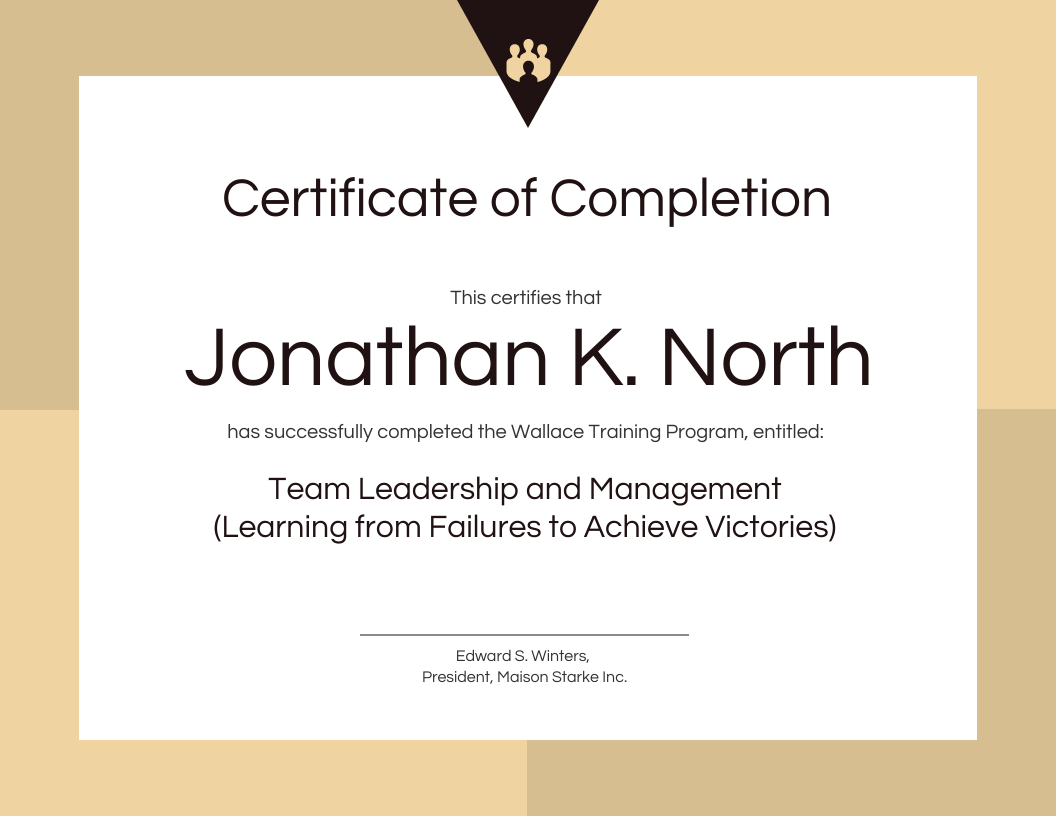
Image source: Venngage
What Information Must You Include on a Professional Certificate?
To maintain credibility, a certificate must include specific data points. Missing information can make the document look amateurish or even fraudulent. According to Certfusion's step-by-step guide, there are seven core components every issuer should include.
- Clear Title: Usually "Certificate of Completion" or "Certificate of Achievement."
- Recipient’s Full Name: Use dynamic fields if automating to ensure perfect spelling.
- Description of Achievement: A brief sentence explaining what the recipient did (e.g., "For successful completion of the Advanced Python Workshop").
- Course or Project Name: The specific title of the training.
- Date of Issuance: The day the requirements were officially met.
- Authorized Signatures: Digital or physical signatures from the instructor or department head.
- Organization Logo: High-resolution branding to verify the source.
Advanced issuers are increasingly adding QR codes for digital verification. This allows employers to scan the document and instantly verify its authenticity against a secure database, which is a significant advancement in preventing credential fraud.
How to Automate Certificate Issuance for Your Students or Employees
Manually editing a Word template for every student is inefficient once your class size exceeds ten people. Modern educators use a "no-code automation stack" to handle issuance instantly. This ensures that as soon as a student hits "Finish," their credential arrives in their inbox.
The No-Code Automation Workflow
-
Step 1: The Trigger
The process begins when a user completes a course in a Learning Management System (LMS) or submits a final form (like Typeform or Google Forms).
-
Step 2: Data Mapping
A tool like Zapier or Make.com catches the user's data (Name, Email, Date) and sends it to a PDF generation service like CraftMyPDF.
-
Step 3: Dynamic Generation
The PDF generator injects the data into a pre-designed template, creating a unique, high-resolution file for that specific user.
-
Step 4: Automated Delivery
The system automatically emails the PDF to the student and can even post a copy to a cloud storage folder for your records.
This workflow not only saves hours of administrative work but also provides a superior experience for the learner, who receives immediate gratification for their hard work.
Why Didn't I Receive My Certificate After Finishing a Course?
One of the most common frustrations for online learners is the "Ghost Certificate"—the phenomenon where a course is finished, but the credential remains locked. This often stems from technical requirements rather than actual system failures. Based on troubleshooting data from the NVIDIA developer forums and other LMS platforms, here is a checklist to resolve the issue.
The "Ghost Certificate" Checklist
- Hidden Grading: Many platforms have a "Submit for Evaluation" button that must be clicked after the final module is finished.
- Module Completion: Some systems require every single video to be watched to the very last second. If you skipped the final 5 seconds of a "Thank You" video, the system may mark the module as 99% complete.
- Mandatory Evaluations: It is a common practice for platforms to withhold the certificate until the student completes a course feedback survey.
- Browser Cache: Sometimes the "Download" button is active, but your browser is showing a cached version of the page. Try a hard refresh (Ctrl+F5).
- Verification Requirements: Ensure your profile name is verified. Some platforms won't issue a document if the "Legal Name" field is blank.
How to Use Your Certificate to Boost Your Career on LinkedIn
Simply uploading a PDF to your LinkedIn profile rarely results in meaningful career growth. To stand out, you must adopt a "Project-First" strategy. Career experts, including those featured on TheOyinbooke's career channel, suggest that the real value lies in the application of the skill, not the paper itself.
The Project-First Strategy
Instead of just posting the certificate image, create a post that showcases a Proof of Work. For example, if you earned a certificate in Data Visualization, share a screenshot of a dashboard you built using those skills. Tag the instructor and mention one specific, difficult concept you mastered during the course. This demonstrates to recruiters that you didn't just "watch the videos," but actually integrated the knowledge.
Adding to the "Licenses & Certifications" Section
To add the credential formally to your profile:
- Navigate to your profile and scroll to the Licenses & Certifications section.
- Click the + icon.
- Enter the exact name of the certificate and the issuing organization.
- Provide the Credential URL. This is a public link provided by the issuer that allows anyone to verify the document's authenticity.
- Add the specific skills associated with the certificate so they appear in your "Skills" section.
Understanding the Certificate of Final Completion in Construction
In the construction industry, this document is far more than a token of participation; it is a legally binding instrument. According to Essex.org's official documentation, the Certificate of Final Completion signifies that the work is finished according to the contract terms.
The document requires a "sign-off block" involving three distinct parties: the Contractor, the Engineer (or Architect), and the Owner. Without all three signatures, the project is not legally finished, which can lead to the "Withholding Trap." This occurs when an owner refuses to sign off on minor "punch list" items to delay the final 5-10% payment (retention). Understanding your local lien laws and contract requirements is essential for navigating these disputes.
Choosing the Right Colors and Design for Your Industry
Design psychology plays a significant role in how a credential is perceived. A certificate for a "Creative Coding" class should look vastly different from one for "Hazardous Waste Management." Using the right color palette can reinforce the authority of the document.
| Industry | Recommended Colors | Psychological Impact |
|---|---|---|
| Technology & Innovation | Purple & Electric Blue | Creativity, future-thinking, and sophistication. |
| Health & Environment | Green & White | Growth, safety, and cleanliness. |
| Finance & Law | Navy & Gold | Trust, prestige, and traditional authority. |
| Construction & Safety | Red, Grey & Black | Urgency, stability, and industrial strength. |
Font choice is equally important. Serif fonts (like Times New Roman or Georgia) evoke a sense of tradition and academic history. Sans-serif fonts (like Arial or Helvetica) feel modern, efficient, and tech-forward. For a top-tier professional look, consider a "mixed" approach: a bold sans-serif for the recipient's name and a classic serif for the body text.
Key Takeaways for Professional Success
- Verify the Purpose: Understand if you need a certificate for participation (learning) or a certification for licensure (legal requirement).
- Use Industry-Standard Templates: Stick to 8.5 x 11 inch layouts and use color psychology that matches your field.
- Include All Core Components: Ensure the title, recipient name, date, and authorized signatures are clearly visible.
- Automate for Scale: Use tools like Zapier and CraftMyPDF to handle issuance if you have more than a few students.
- Troubleshoot "Ghost" Certificates: Check for hidden evaluation forms or incomplete video modules if your document isn't generating.
- Leverage LinkedIn: Share your certificate alongside a "proof of work" project to catch the eye of recruiters.
- Construction Legalities: Ensure all three parties sign the final completion document to trigger payments and warranties.
Start by selecting a template that aligns with your industry's professional standards and begin documenting your learning journey today.