How to Create a Cleaning Business Proposal Template That Wins High-Value Contracts
A winning cleaning business proposal template requires more than just a price tag—it acts as a professional roadmap that defines your scope of work, proves your quality assurance, and establishes legal boundaries. According to industry data, utilizing professional templates with integrated e-signatures can lead to 60% faster client approvals.
Ready to start bidding? Access standard proposal formats below to customize for your next commercial walkthrough.
Securing a lucrative commercial cleaning contract rarely comes down to being the cheapest option. Facility managers and business owners are looking for reliability, transparency, and a clear understanding of their specific needs. If your current bidding process consists of emailing a brief price quote, you are likely leaving substantial money on the table.
A highly optimized cleaning business proposal template bridges the gap between a simple quote and a binding service agreement. It demonstrates your professionalism, outlines exactly what the client is paying for, and protects your profit margins from scope creep. In this comprehensive breakdown, we will explore exactly how to structure your proposal, how to conduct a site walkthrough that informs your bid, and how to tailor your documents for high-margin niches like medical facilities and post-construction sites.
What Should You Include in a Professional Cleaning Proposal?
The anatomy of a successful janitorial bid is relatively standardized across the industry, yet many new business owners omit critical sections that build trust. To outperform low-bid competitors, your template must include the following core components.
A Professional Cover Page and Executive Summary
Your cover page is the first impression. It should prominently feature your company logo, the client's name and facility address, the date of submission, and your direct contact information. Following the cover page, the Executive Summary serves as your "Hook."
Instead of launching immediately into pricing, the Executive Summary explains why your company is the right fit for this specific facility. According to proposal software providers like Proposify, personalizing this section to address the client's specific pain points drastically increases win rates. If the client mentioned during the walkthrough that their previous cleaners constantly missed the baseboards or left the restrooms smelling poorly, your Executive Summary should explicitly state how your team addresses those exact issues.
Detailed Scope of Work and Service Frequency
The Scope of Work (SOW) is the most heavily scrutinized section of any cleaning proposal. Facility managers want to know exactly what tasks will be performed and how often. Vague descriptions like "clean the office" lead to disputes. Instead, break your SOW down into a highly specific matrix.
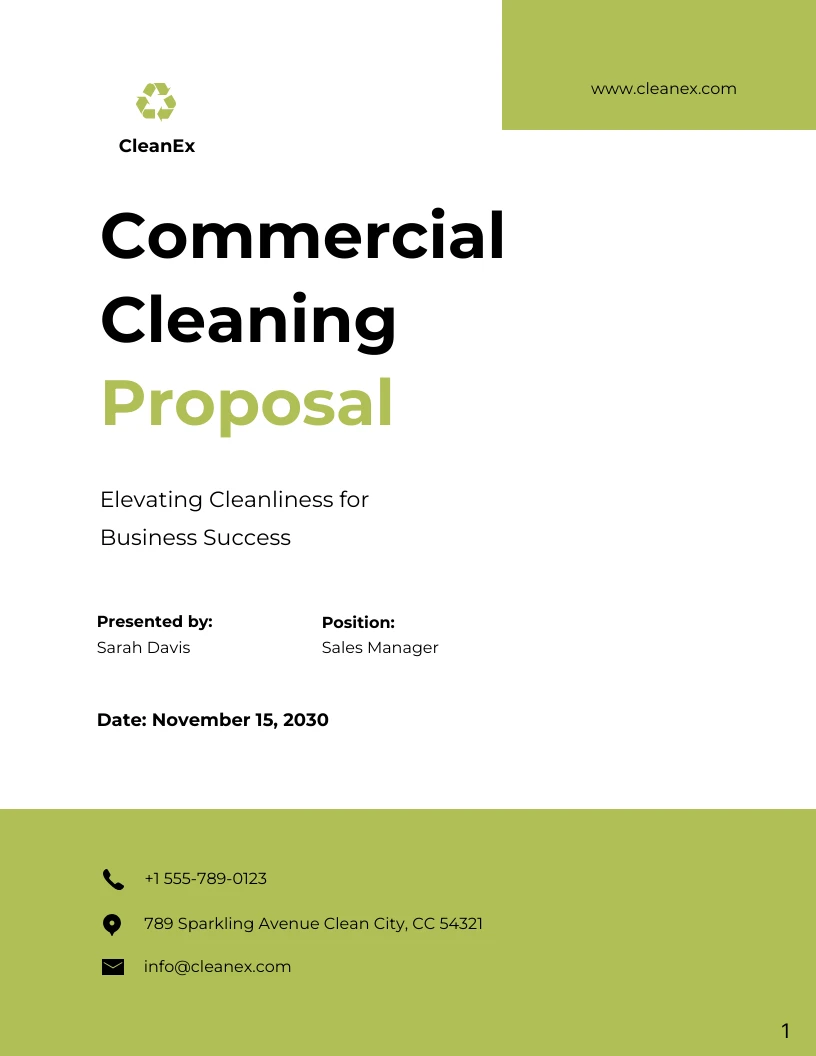
Image source: Venngage
A standard commercial SOW should be categorized by frequency:
- Daily Tasks: Emptying all trash receptacles, replacing liners, vacuuming high-traffic areas, sanitizing restroom fixtures, restocking paper products, and mopping hard floors.
- Weekly Tasks: Dusting all horizontal surfaces (desks, filing cabinets), polishing interior glass and mirrors, and deep-cleaning microwave interiors in the breakroom.
- Monthly Tasks: High-dusting HVAC vents, wiping down baseboards, vacuuming upholstered furniture, and machine-scrubbing restroom floors.
Transparent Pricing and Investment Tables
One of the most common reasons cleaning businesses lose bids is a lack of pricing transparency. Presenting a single, lump-sum number can cause sticker shock. Instead, use an investment table that breaks down the costs.
According to Aspire's commercial cleaning guidelines, providing line-item transparency builds immense trust. Separate your pricing into the core monthly janitorial fee, the cost of initial deep cleans, and optional add-on services (like quarterly carpet extraction or bi-annual VCT floor stripping and waxing). This not only justifies your primary fee but also serves as a built-in upselling mechanism.
Quality Assurance and Communication Protocols
Every cleaning company claims to provide "high-quality service." To win the contract, you must prove how you measure and maintain that quality. This is where you introduce your Quality Assurance (QA) protocols.
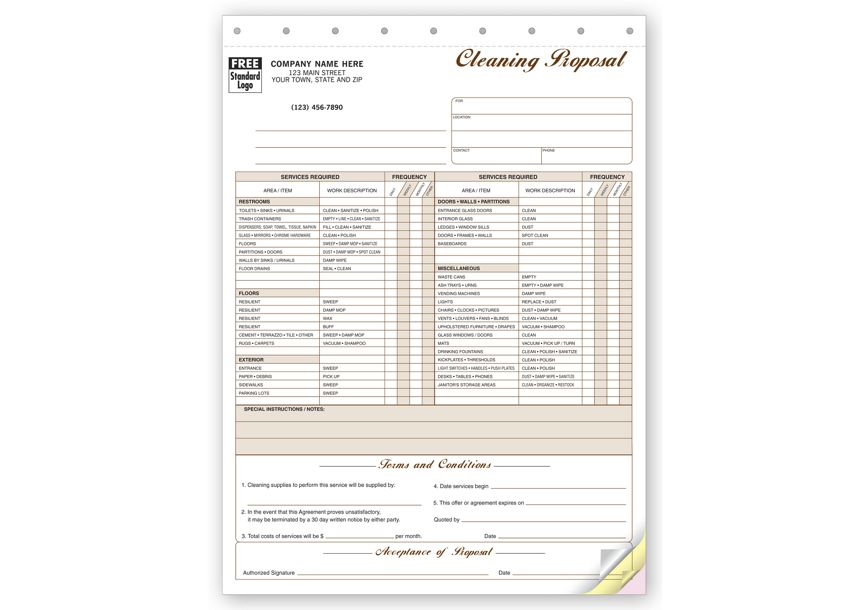
Image source: Deluxe
Detail the technology and processes you use to keep your team accountable. Do your cleaners use GPS-tracked timekeeping apps? Do your supervisors perform random monthly site inspections using a digital scorecard? For example, national franchises like JAN-PRO utilize proprietary tracking systems as a major selling point in their proposals. Even if you are an independent operator, outlining a clear "Communication Log" process shows the client you take accountability seriously.
To instantly differentiate yourself from low-bid competitors, include a "24-Hour Resolution Guarantee" in your proposal. State clearly: "If you are ever dissatisfied with a specific cleaning task, notify us by 10:00 AM the following day, and we will dispatch a team member to correct the issue within 24 hours at no additional charge." This removes the perceived risk for the facility manager.
How to Conduct a Pre-Proposal Site Walkthrough That Seals the Deal
A critical mistake many cleaning business owners make is attempting to generate a proposal "sight unseen" based solely on square footage. While square footage is a factor, it does not account for the density of the space, the types of flooring, or the current state of the facility. A pre-proposal site walkthrough is your opportunity to gather the intelligence needed to write a winning, customized bid.
During the walkthrough, you are not just measuring rooms; you are actively looking for the previous cleaning company's failures. These failures become the focal points of your proposal.
Never arrive at a walkthrough empty-handed. Bring a laser measuring tool (or measuring wheel) to verify square footage, a high-lumen flashlight to inspect dark corners and under desks, a digital tablet or clipboard for notes, and a camera (with permission) to document areas requiring initial deep cleaning.
The Walkthrough Checklist:
- Floor Wear and Tear: Are the VCT floors yellowing? This indicates a buildup of old wax. You can add a "Strip and Wax" line item to your proposal.
- Restroom Odor Sources: Check the grout lines around urinals and toilets. Lingering odors usually mean the previous cleaners were mopping with dirty water rather than using proper enzymatic cleaners on the grout.
- Hidden Dust Zones: Run your finger along the top of door frames, fire extinguishers, and HVAC return vents. These are the first areas neglected by rushed cleaning crews.
- Trash Density: A 5,000 square foot open-plan office with 50 individual desk trash cans takes significantly longer to clean than a 5,000 square foot warehouse with three central centralized bins.
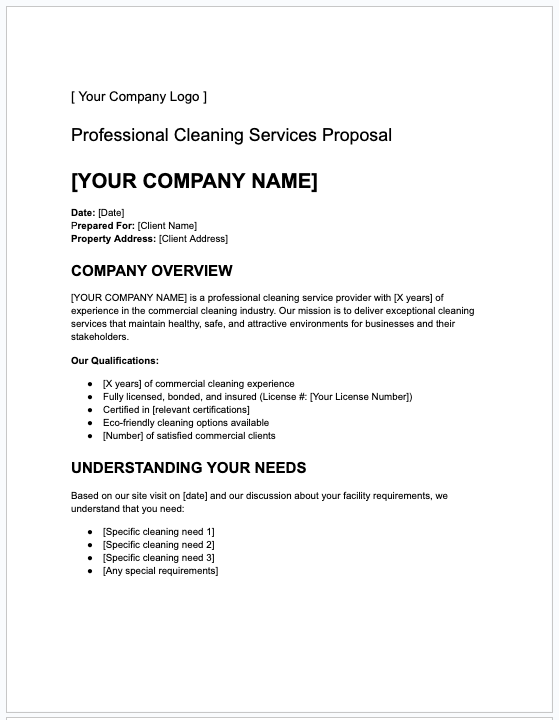
Image source: Swept Janitorial Software
Customizing Your Proposal for Different Cleaning Niches
A generic "office cleaning" template will not suffice if you are bidding on specialized facilities. Different industries have vastly different regulatory requirements and hygiene standards. Your proposal must reflect an understanding of these niche-specific demands.
Requirements for Medical and Healthcare Facilities
Bidding on medical offices, dental clinics, or outpatient surgical centers requires a completely different vocabulary. Facility managers in healthcare are primarily concerned with infection control, cross-contamination, and compliance with OSHA and HIPAA regulations.
In a medical cleaning proposal, your Scope of Work must highlight terminal cleaning procedures and pathogen control. You should explicitly state that your staff uses hospital-grade, EPA-registered disinfectants and adheres to color-coded microfiber systems (e.g., red cloths for restrooms, blue for exam rooms) to prevent cross-contamination. Mentioning adherence to specific medical metrics or bloodborne pathogen training will elevate your proposal above standard janitorial bids.
Requirements for Post-Construction Cleanup
Post-construction cleaning is a highly lucrative, high-margin niche, but the proposals look very different from recurring janitorial contracts. These are typically one-time, phased projects.
According to Jotform's template guidelines, a post-construction proposal must address the removal of fine drywall dust, the safe disposal of hazardous or heavy materials, and the phasing of the clean (e.g., Rough Clean, Final Clean, and Touch-Up Clean). Your proposal must also clearly define what is not included, such as exterior window washing at heights requiring scaffolding, unless you are specifically licensed and insured for it.
Requirements for Gyms and Fitness Centers
Fitness centers present unique challenges due to high foot traffic, sweat, and humidity. A proposal for a gym must heavily emphasize high-touch equipment sanitization and locker room hygiene.
Your SOW should detail the frequency of wiping down cardio machines, sanitizing free weights, and managing the high volume of trash and towel services. Furthermore, locker rooms require aggressive fungicidal treatments in showers to prevent mold and mildew buildup—a detail that should be prominently featured in your service description.
Scope of Work Comparison by Niche
| Cleaning Niche | Primary Client Concern | Key Proposal Vocabulary | Critical SOW Inclusions |
|---|---|---|---|
| Standard Commercial | Visual appearance, employee morale | Dusting, vacuuming, restocking, reliable | Daily trash removal, restroom sanitation, breakroom cleaning |
| Medical / Healthcare | Infection control, compliance | Pathogen control, EPA-registered, cross-contamination | Color-coded microfiber use, exam room sanitization, biohazard awareness |
| Post-Construction | Safety, timeline, detail work | Fine dust removal, phased cleaning, rough clean | HVAC vent vacuuming, sticker removal from glass, floor prep |
| Fitness Centers | Odor control, hygiene | High-touch sanitization, fungicidal, humidity | Equipment wipe-downs, shower scrubbing, mirror polishing |
Which Pricing Model Should You Use for Your Cleaning Bid?
Determining how to price your services is often the most stressful part of creating a proposal. Manual bidding without a clear framework often leads to inaccurate cost calculations and unprofitable bids. There are three primary pricing models used in the commercial cleaning industry, and choosing the right one depends on the scope of the project.
1. The Hourly Rate Model
Best for: One-time deep cleans, post-construction, and highly unpredictable environments.
In this model, you estimate the total number of labor hours required and multiply it by your hourly bill rate (which includes your labor cost, overhead, taxes, and profit margin). If your bill rate is $45/hour and a deep clean will take a team of two people 5 hours (10 total labor hours), your bid is $450. While safe for the cleaning company, many commercial clients dislike hourly rates for recurring work because the monthly cost can fluctuate.
2. The Square Footage Model
Best for: Large commercial offices, warehouses, and schools.
This is the industry standard for large spaces. You charge a set amount per square foot based on the density and cleaning frequency. For example, a 10,000 square foot office might be billed at $0.12 per square foot per clean. If you clean it 3 days a week (roughly 13 cleans a month), the math is: 10,000 x $0.12 = $1,200 per clean. $1,200 x 13 = $15,600 monthly. The exact cent-per-square-foot rate varies wildly based on your local market and the facility type.
3. The Flat Monthly Fee Model
Best for: Standard recurring janitorial contracts (small to medium offices).
This is the most common model presented in cleaning proposals. You calculate your internal costs (labor hours, supplies, overhead) and add your profit margin (typically 10% to 20% for commercial contracts) to arrive at a flat monthly rate. Clients prefer this because it allows for predictable budgeting. For instance, quoting a flat $850 per month for twice-a-week cleaning is easier for a client to digest than a complex hourly breakdown.
Is a Cleaning Proposal the Same as a Legal Contract?
A common point of confusion among new cleaning business owners is the legal weight of a proposal. Is it just a pitch, or is it a binding contract? The answer depends entirely on how you structure the document.
A standard proposal is essentially a "Pitch." It outlines what you intend to do and how much it will cost. However, a proposal becomes a legally binding Service Agreement only when it includes specific "Terms and Conditions" and is signed by an authorized representative of the client's company.
If you are bidding on a massive corporate facility, the client will typically require a separate Master Service Agreement (MSA) drafted by their legal team. But for small to medium-sized businesses, your proposal can serve as the contract if you include the following legal clauses:
- Payment Terms: Specify when invoices are sent (e.g., the 1st of the month) and when payment is due (e.g., Net 15 or Net 30 days). Include late fee percentages for overdue invoices.
- Term and Cancellation: Define the length of the agreement (typically 1 year) and the notice required to cancel (usually 30 days written notice).
- Insurance and Indemnification: State that your company carries general liability and workers' compensation insurance. An indemnification clause protects both parties from certain liabilities.
- Holidays and Access: Clarify which national holidays your team observes and how facility access (keys, alarm codes) will be securely managed.
How to Use Technology to Close Deals Faster
The days of printing a proposal, driving it to a client's office, and waiting weeks for a physical signature are over. Modern cleaning businesses leverage technology to streamline the bidding process and secure contracts rapidly.
The Power of E-Signatures and Digital Delivery
Integrating electronic signatures into your proposal workflow is one of the highest-ROI changes you can make. According to data from BetterProposals, whose templates have secured millions in contracts, digital delivery removes friction. When a facility manager can review your PDF or web-based proposal on their phone and sign it with their finger, the time-to-close drops dramatically.
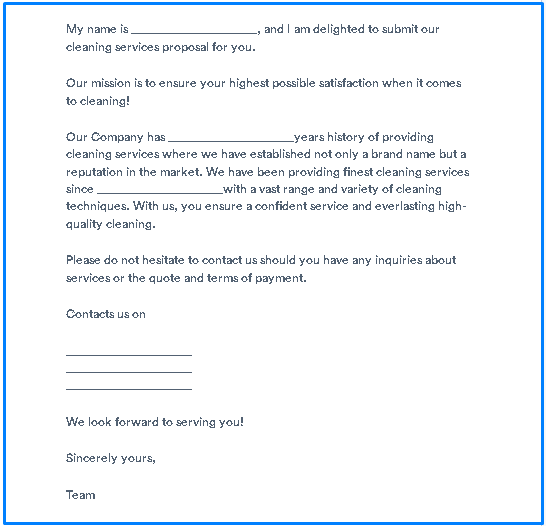
Image source: Signaturely
Why Security Matters for Commercial Clients
When you send a proposal to a commercial client, you are often handling sensitive information, including facility floor plans, security protocols, and financial terms. Sending a standard Word document as an email attachment can be perceived as unprofessional or insecure by enterprise clients.
Utilizing dedicated proposal software (like PandaDoc, Revv, or Proposify) allows you to send your bid via an encrypted link (typically 256-bit SSL encryption). This not only protects the document from being altered but also provides you with analytics—you can see exactly when the client opened the proposal and which pages they spent the most time reading.
Frequently Asked Questions
Final Thoughts
Winning commercial cleaning contracts requires shifting your mindset from simply "giving a quote" to presenting a comprehensive business solution. A well-crafted proposal template protects your margins, sets clear client expectations, and establishes your company as a professional authority.
- Conduct a thorough site walkthrough using a checklist to identify specific facility pain points before ever drafting your bid.
- Customize your Executive Summary to directly address the unique issues you discovered during the walkthrough, rather than using a generic greeting.
- Detail your Scope of Work by breaking tasks down into daily, weekly, and monthly frequencies to prevent scope creep.
- Separate your pricing into transparent line items, distinguishing between the core monthly fee and optional deep-cleaning add-ons.
- Include specific Quality Assurance proof points, such as digital inspection scorecards or a 24-hour resolution guarantee, to build immediate trust.
- Define your legal boundaries by including clear Terms and Conditions covering payment schedules, cancellation notices, and insurance.
- Utilize e-signature technology to deliver your proposal securely and reduce client approval times by up to 60%.