How to Choose and Use a Weekly Chore List Template for Your Home
A structured weekly chore list template transforms chaotic households into organized environments by making "invisible labor" visible and distributing responsibilities fairly. Whether you need a gamified chart for children, a neutral PDF for adult roommates, or an automated Google Sheet, the key to success is matching the template format to your household's specific routines. Implementing a written schedule reduces decision fatigue, minimizes nagging, and ensures daily maintenance tasks are completed consistently.
Managing a household often feels like a never-ending cycle of tidying, scrubbing, and organizing. Without a clear system, the burden of maintaining a clean home typically falls disproportionately on one person, leading to frustration and burnout. Implementing a weekly chore list template is a highly effective strategy to distribute tasks, set clear expectations, and maintain a baseline of cleanliness without spending your entire weekend catching up.
Why a Written Chore List Changes Your Home’s Energy
Transitioning from a verbal agreement to a written chore schedule fundamentally alters how a household operates. The primary advantage is the reduction of the "mental load"—the exhausting, invisible work of noticing what needs to be done, planning when to do it, and delegating the task.
The Mental Load and Decision Fatigue
When chores are not documented, household members suffer from decision fatigue. Every evening becomes a negotiation about who will load the dishwasher or take out the trash. A visible, written list eliminates this friction. According to organizational psychology principles highlighted by 101Planners, a structured chart removes the "nagging cycle" because the authority shifts from the parent or proactive roommate to the document itself.
Psychological Benefits and Dopamine
Checking a box or placing a sticker on a completed task provides a micro-release of dopamine, the brain's reward chemical. For children, this visual progress teaches time management, prioritization, and accountability. For adults, it provides a tangible sense of accomplishment at the end of a long workday, transforming an abstract feeling of "I cleaned the house" into a concrete list of achievements.
Solving the "Invisible Labor" Problem
Many vital household tasks go unnoticed until they become a problem. Wiping down baseboards, descaling the coffee maker, and sanitizing light switches are forms of invisible labor. A comprehensive template brings these tasks into the light, ensuring all household members understand the full scope of what it takes to run the home.
Core Weekly Chore List Templates You Can Edit
Not all households operate the same way, which is why a one-size-fits-all approach rarely succeeds. Depending on your living situation, you will want to select a template format that aligns with your household's aesthetic preferences and technical comfort levels.
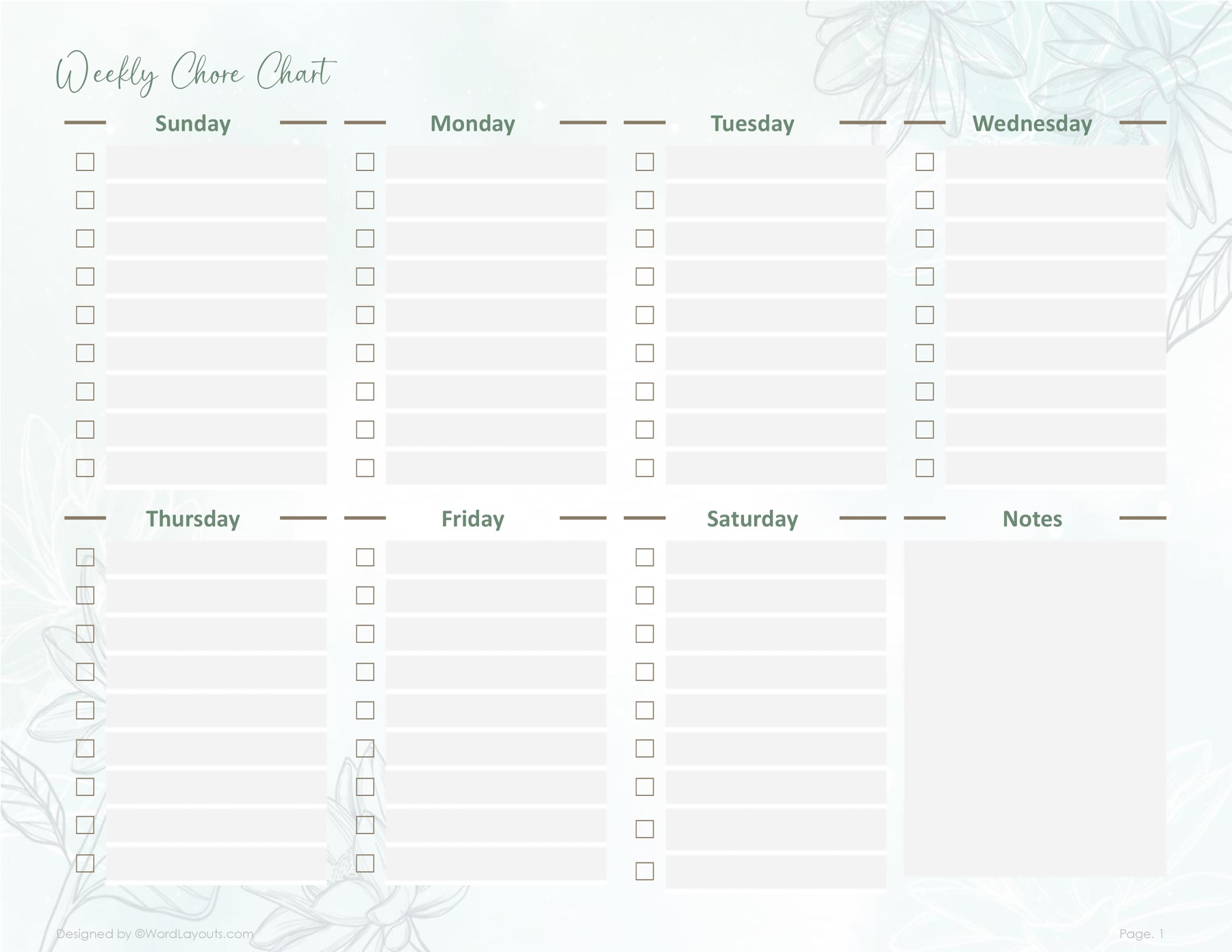
Image source: WordLayouts
1. The Minimalist Professional (PDF/Word)
Designed for adults and roommates, this style features a clean, high-white-space design with neutral tones and serif fonts. It avoids the playful graphics associated with children's charts, focusing instead on clear categorization. You can find highly customizable, professional layouts through platforms like WordLayouts, which offer formats in .docx, Google Docs, and PDF.
2. The Gamified Kid’s Chart (Printable)
For households with young children, visual engagement is critical. These templates utilize bright colors, icon-based task descriptions for pre-readers (e.g., a picture of a toy box for "pick up toys"), and dedicated sections for star ratings or stickers. Pinterest and Day Designer offer numerous printable options that focus on positive reinforcement.
3. The Automated Digital Dashboard (Google Sheets/Excel)
For tech-savvy families, a digital spreadsheet offers advanced tracking. These templates utilize conditional formatting—where a cell automatically turns green when a checkbox is clicked—and often feature a progress bar at the top of the sheet. This format is highly recommended for older teens and adults who prefer managing tasks via their smartphones.
4. The "Roommate Social Contract" Template
Living with peers requires a different approach than living with family. A roommate template goes beyond a simple checklist by including a "Social Contract" section. This area outlines conflict resolution steps and "buy-out" options, ensuring everyone agrees on the consequences of missed tasks before the month begins.
What Tasks Belong on Your Weekly Schedule?
A common mistake when setting up a chore list is treating all tasks equally. To prevent overwhelm, tasks should be categorized by frequency and effort level. Structuring your template into distinct tiers ensures that essential hygiene is maintained without expecting a deep clean every single day.
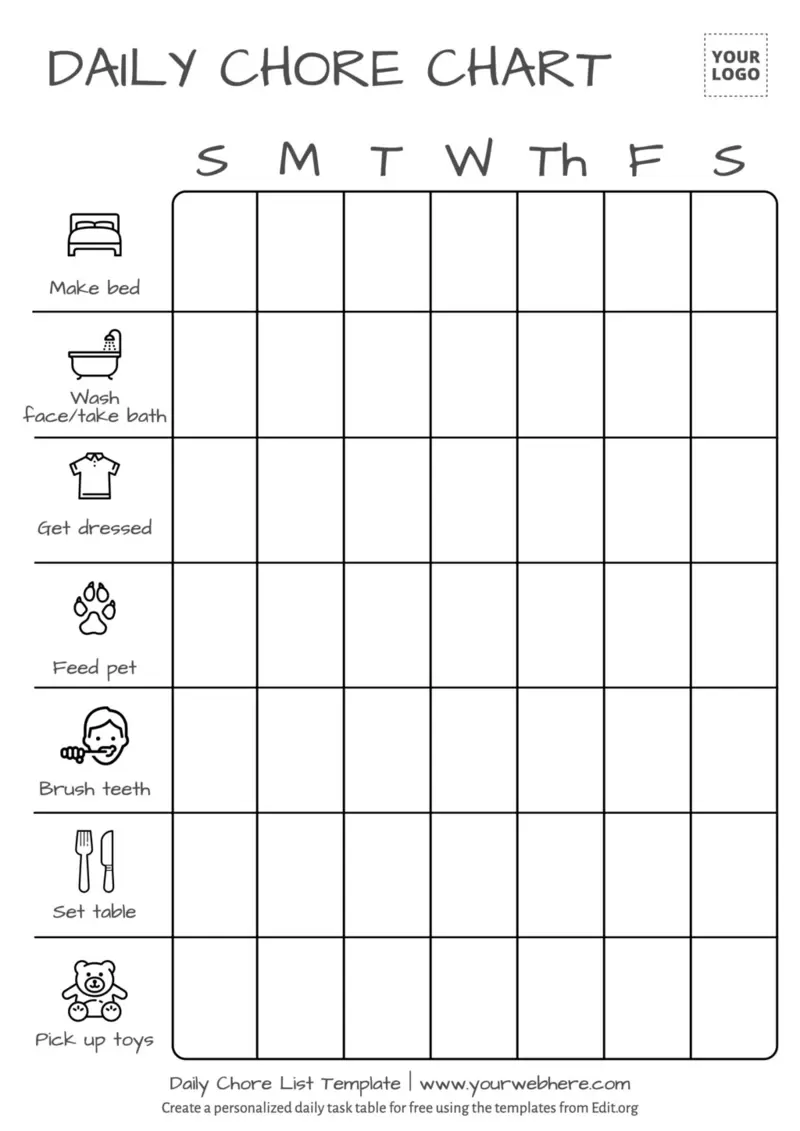
Image source: Edit.org
The Daily Maintenance Tier
Daily These are the non-negotiable tasks that prevent a home from descending into chaos. They are typically low-effort but high-impact. Examples include:
- Loading and running the dishwasher every evening.
- Wiping down kitchen counters and the dining table after meals.
- Executing a 15-minute "power tidy" of high-traffic areas (living room, entryway).
- Completing one full load of laundry (washed, dried, folded, and put away) to prevent weekend laundry mountains.
The Weekly Deep-Clean Tier
Weekly These tasks maintain the hygiene and deeper cleanliness of the home. They require more time and are usually assigned to specific days (e.g., "Bathroom Saturday"). According to cleaning schedules outlined by BeTidy, weekly tasks should include:
- Scrubbing toilets, bathtubs, and shower walls.
- Stripping beds and washing all linens.
- Vacuuming all carpets and mopping hard floors.
- Cleaning out the refrigerator and discarding expired food before trash day.
The Monthly "Deep-Rotation" Logic
Monthly Instead of listing every deep-cleaning task on a massive monthly list, integrate a "Deep-Rotation" section at the bottom of your weekly template. In this system, one specific zone is added to the weekly list on a 4-week cycle. For example:
- Week 1: Clean window tracks and wash interior glass.
- Week 2: Pull out kitchen appliances and clean behind them.
- Week 3: Wipe down all baseboards and door frames.
- Week 4: Deep clean the washing machine and dishwasher filters.
Pet Care Integration
If you have animals, pet care must be explicitly listed. Daily tasks include washing food/water bowls (which harbor significant bacteria) and scooping litter boxes. Weekly tasks should include brushing pets to reduce shedding and washing pet bedding.
How to Use AI to Create a Custom Cleaning Schedule
Static templates are an excellent starting point, but they often require heavy modification. A generic list designed for a two-bedroom apartment will not serve a 2,500-square-foot home with three pets and a toddler. As demonstrated in various productivity tutorials, leveraging Artificial Intelligence is a highly efficient way to generate a hyper-specific chore list in seconds.
To get the most accurate output, you must use the "Prompt Engineering" method. Copy and paste the following prompt into ChatGPT or Claude, adjusting the bracketed information to fit your life:
"Act as an expert home organizer. Create a weekly chore list for a [2,500 sq ft home] with [2 working adults, 1 toddler, and a shedding dog]. Categorize the list into Daily Maintenance, Weekly Deep Cleans, and a Monthly Rotation. Focus on 20-minute 'power clean' tasks suitable for busy parents. Format the output as a table."
Refining the AI Output
Once the AI generates the initial list, you can refine it further. If you know your energy levels dip mid-week, ask the AI to adjust the schedule:
- Step 1: Request energy-based sorting. Prompt: "Reorganize the weekly tasks so that low-energy chores (like folding laundry) are scheduled for Wednesday and Thursday, and high-energy chores (like mopping) are on Saturday."
- Step 2: Ask for age-appropriate delegation. Prompt: "Extract three safe, simple tasks from this list that a 4-year-old can help with."
- Step 3: Export the final table directly into Excel or Google Sheets for formatting and printing.
Adapting Your Chore List for Neurodivergent Households
Traditional Monday-through-Sunday chore charts often fail in households managing ADHD or executive dysfunction. Rigid schedules can trigger overwhelm, leading to task paralysis where nothing gets done.
Dopamine-Hit Design
For neurodivergent individuals, the visual design of the template is just as important as the tasks themselves. Incorporate visual progress bars or color-coding. Breaking a large task like "Clean Kitchen" into micro-tasks ("Empty dishwasher," "Wipe left counter," "Wipe right counter") provides more opportunities to check a box, delivering the dopamine hits necessary to maintain momentum.
The "Body Doubling" Strategy
Add a specific column on your template for "Body Doubling" tasks. Body doubling is a productivity technique where two people work in the same room simultaneously. Even if they are doing different chores (e.g., one person chops vegetables for meal prep while the other unloads the dishwasher), the shared presence acts as an anchor, significantly reducing distraction.
Flexible Frequency Over Rigid Days
Instead of assigning "Vacuuming" strictly to Tuesday, alter the template to a "Flexible Frequency" model. List "Vacuuming" with three checkboxes next to it, indicating it needs to be done three times a week, on whatever days the person has the energy to complete it. This accommodates fluctuating executive function levels while still ensuring the task is completed.
Should You Pay Your Kids for Doing Chores?
When customizing a chore list template for a family, parents inevitably face the debate of whether to tie chores to an allowance. There are two primary philosophies, and your template design will change depending on which you choose.
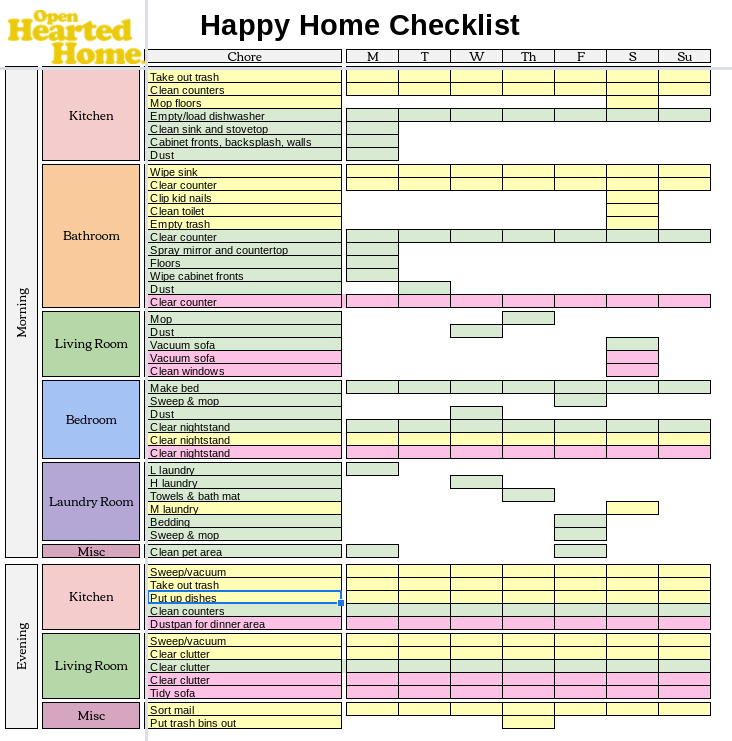
Image source: Open Hearted Home
| Philosophy | Core Concept | Pros | Cons |
|---|---|---|---|
| The Responsibility Model | Chores are an unpaid contribution to the family "tribe." Everyone lives here, so everyone cleans. | Builds intrinsic motivation and a sense of teamwork. | Lacks the immediate financial incentive that motivates some children. |
| The Incentive Model | Chores are treated as a job. Children earn a "commission" for completed tasks. | Teaches the direct correlation between work and earning money. | Kids may refuse to do basic tasks if they decide they don't need the money that week. |
The Hybrid Approach
Many child development experts recommend a hybrid approach. In this model, your template is divided into two sections. The top section lists "Required Responsibilities" (unpaid tasks like making their bed, putting dirty clothes in the hamper, and clearing their plate). The bottom section lists "Extra Credit Jobs" (paid tasks like washing the family car, weeding the garden, or organizing the garage). This teaches both family duty and financial literacy.
Managing Chores with Roommates Without the Drama
Roommate chore charts frequently fail because they lack an enforcement mechanism. A piece of paper on the fridge cannot force a roommate to take out the trash. To make a template work in a shared living situation, you must upgrade it to a "Social Contract."
The "Buy-out" Clause
Incorporate a "Buy-out Fund" section into your template. If a roommate is facing a brutal week of exams or overtime at work and cannot complete their assigned deep-cleaning task, they can exercise the buy-out clause. They pay a pre-agreed amount (e.g., $15) into a communal jar or Venmo account, and another roommate can volunteer to do the task for that cash. If no one volunteers, the money goes toward a communal expense, like ordering pizza or buying household supplies.
The Digital-to-Physical Sync (QR Code Method)
Roommates are rarely in the same room at the same time, making physical charts difficult to maintain. Create a hybrid system:
- Set up your chore list in Google Sheets and ensure the sharing settings allow anyone with the link to edit.
- Copy the share link and paste it into a free online QR code generator.
- Print the QR code and tape it to the refrigerator.
- Roommates can scan the code with their phones to instantly open the master sheet and check off their completed tasks in real-time.
The Monthly Check-in
The template is only half the solution; communication is the other half. Schedule a brief, 10-minute "State of the House" meeting on the first Sunday of every month. Use this time to rotate the chore assignments on the template so no one is permanently stuck with cleaning the bathroom.
How to Customize Your Template for Maximum Efficiency
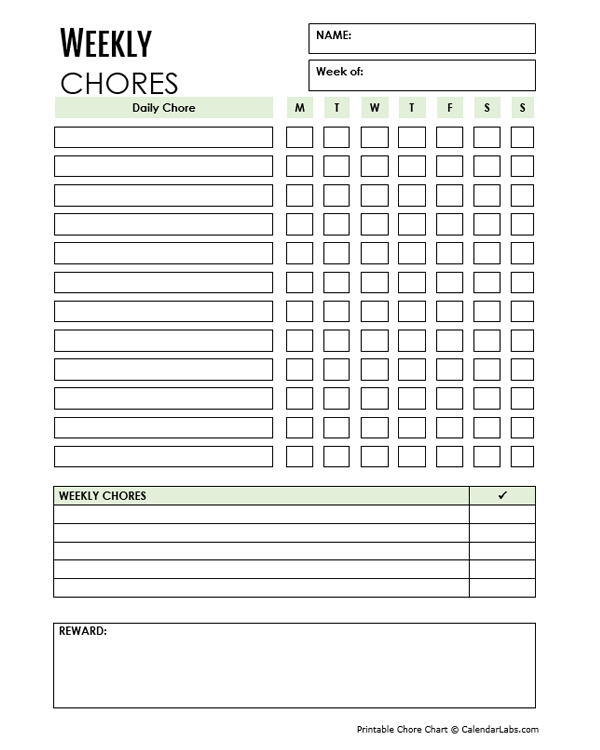
Image source: Calendar Labs
Once you have downloaded a template from a site like Canva or WordLayouts, take the time to customize the layout to match your physical space and cleaning style.
Room-by-Room Breakdown
Instead of a random list of tasks, group chores by location (e.g., Kitchen, Bathrooms, Exterior). This prevents you from walking back and forth across the house, carrying cleaning supplies from room to room. When you are in the bathroom, you complete all bathroom tasks before moving on.
The "Batching" Technique
Alternatively, you can customize your template by "Task Type" to stay in a flow state. Group all glass-cleaning tasks together, all vacuuming together, and all trash-gathering together. It is much faster to walk through the entire house with a bottle of Windex and a microfiber cloth than it is to switch between a vacuum, a mop, and a duster in a single room.
Laminating for Longevity
If you prefer a physical paper chart, printing a new one every week wastes ink and paper. Print your customized template once, place it inside a clear plastic sheet protector, or run it through a home laminator. Use dry-erase markers to check off tasks throughout the week, and simply wipe it clean every Sunday evening.
Frequently Asked Questions
How do I make a chore list in Google Sheets?
What chores are appropriate for a 5-year-old?
How do I get my partner to follow the chore list?
What is an effective way to track monthly chores?
Should I use a digital app or a paper chart?
Final Thoughts on Household Organization
Implementing a weekly chore list template is less about achieving a spotless house and more about creating a predictable, low-stress environment. By making expectations clear and visible, you eliminate the daily friction of negotiating household duties.
- Consistency beats intensity: Committing to 15 minutes of daily maintenance is far more effective than attempting a grueling 5-hour cleaning marathon on Saturday.
- Customize ruthlessly: A template is just a starting point. Delete tasks that don't apply to your living situation and add specific duties unique to your home.
- Involve the whole household: Whether you live with toddlers or adult roommates, building the list together significantly increases long-term compliance and buy-in.
- Embrace flexibility: Use strategies like "buy-out clauses" for roommates or "flexible frequency" for neurodivergent family members to prevent the system from feeling punitive.
- Review regularly: Treat your chore list as a living document. Reassess task distribution every few months as seasons change and schedules shift.
Take 10 minutes today to download a template, customize it for your specific space, and print it out to establish your new household baseline.