A modern SEO strategy template organizes disconnected tasks—keyword research, technical audits, and content creation—into a unified roadmap. As of 2026, a highly effective template must go beyond traditional "blue link" tracking to include Generative Engine Optimization (GEO), citation tracking for AI overviews, and revenue proxy mapping to prove financial value to stakeholders. Using a structured format like Google Sheets or Notion allows teams to operate in 90-day tactical sprints, adapting quickly to algorithm shifts.
What Is an SEO Strategy and Why Do You Need a Template?
An SEO strategy is a long-term action plan designed to improve a website's visibility in search engines. Traditionally, this plan covers three foundational pillars: on-page relevance, off-page authority, and technical performance. However, having a strategy in your head—or scattered across multiple software tools—is a recipe for execution failure.
This is where the distinction between a strategy and a roadmap becomes critical. According to industry experts at seoClarity, a strategy defines the "what" and the "why," while a roadmap dictates the "how" and the "when." An SEO strategy template serves as the bridge between the two, functioning as a strategic document that keeps daily activities aligned with annual goals.
One of the primary benefits of using a centralized template is its function as a "silo-killer." In many marketing departments, keyword research lives in a specialized SEO tool, content briefs live in Google Docs, and reporting lives in Looker Studio. A comprehensive template, as noted by project management platforms like Asana, forces all these elements into a single source of truth. This prevents misalignment between the SEO team identifying the keywords and the content team writing the articles.
Furthermore, the context of search has shifted dramatically in 2026. The focus has moved away from merely ranking for individual keywords toward owning topical entities and securing visibility within AI-generated answers. A modern template must account for these new variables, tracking not just where a page ranks, but whether the brand is cited as an authoritative entity by large language models.
Download Your Free SEO Strategy Template in Multiple Formats
Because different teams have different operational workflows, there is no single format that works for everyone. Data-heavy teams often prefer spreadsheets, while content-heavy teams lean toward documentation apps, and execution-focused teams require project management software.
When building your own template, you should ensure it includes the following core tabs or sections:
- Goal Setting & Benchmarks: Current traffic, baseline metrics, and SMART goals.
- Technical Audit Tracker: Checklists for site speed, crawl errors, and indexability.
- Keyword & Entity Map: Seed keywords, search intent, volume, and target URLs.
- Content Production Pipeline: Brief status, writer assignment, and publication dates.
- AI/GEO Citation Tracker: Monitoring brand mentions in AI Overviews and ChatGPT.
- Reporting & Revenue Proxy: Mapping organic traffic to estimated pipeline value.
To help you choose the right foundation for your workflow, review the comparison table below detailing the strengths of the three most popular template formats.
| Platform Format | Primary Strength | Ideal Use Case | Drawbacks |
|---|---|---|---|
| Google Sheets / Excel | Data manipulation and formulas | Large-scale keyword mapping and VLOOKUP revenue tracking. | Poor for long-form text (content briefs) and task collaboration. |
| Notion / Confluence | Documentation and linked databases | Creating a wiki-style strategy where briefs link directly to the roadmap. | Lacks advanced data processing and automated API integrations. |
| Asana / Monday.com | Task management and deadlines | Managing the 90-day tactical sprint and holding team members accountable. | Not suitable for storing raw keyword data or technical audit logs. |
The Four-Step Orchard Framework for Sustainable Organic Growth
When structuring the workflow within your template, it helps to follow a proven methodology. Ahrefs popularized the "Orchard Framework," which breaks the SEO lifecycle into four distinct, cyclical phases: Plan, Plant, Grow, and Harvest. Integrating these phases into your template ensures a balanced approach to organic growth.
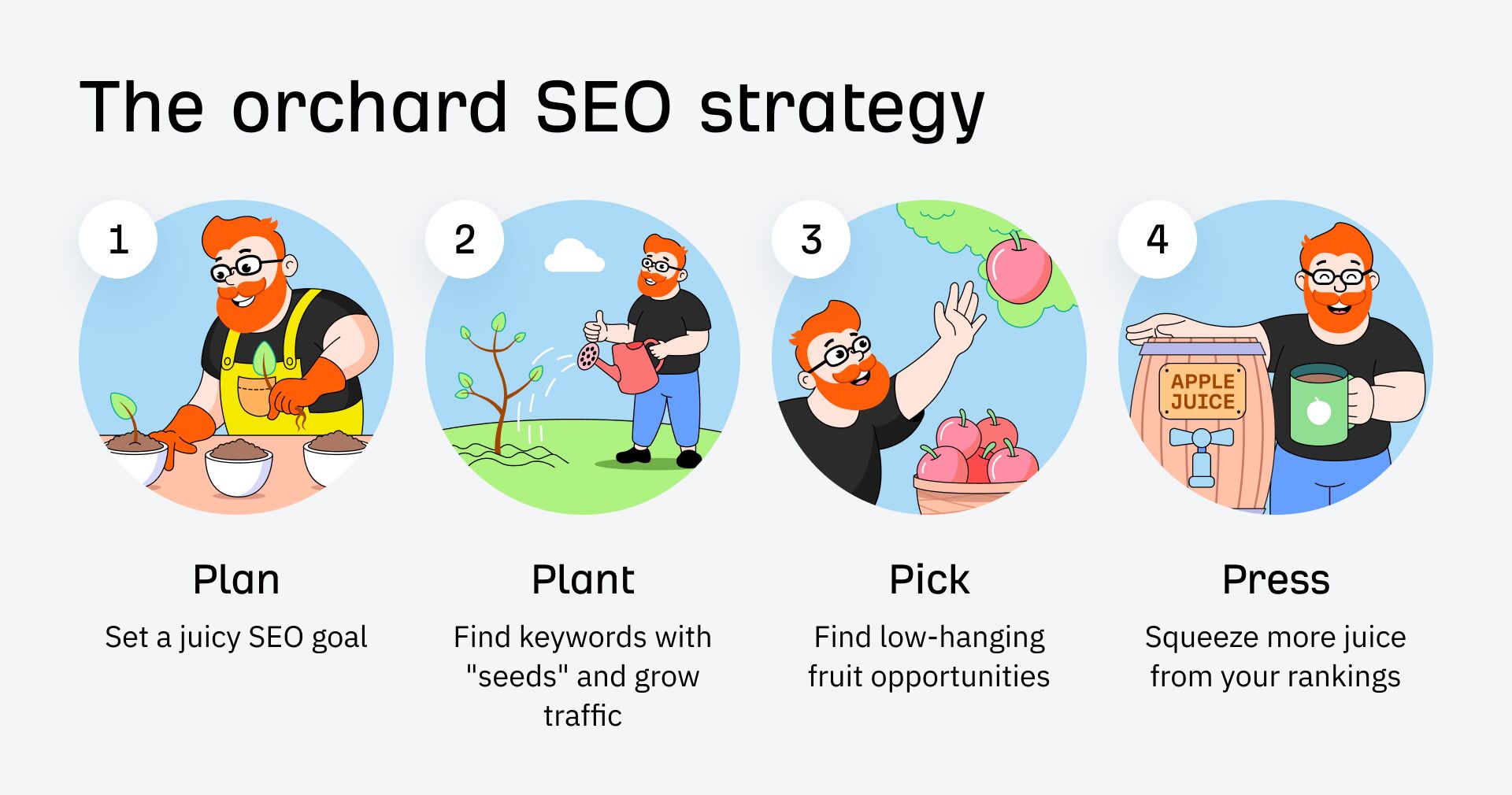
Image source: Ahrefs
- Step 1: Plan (Benchmarking and Auditing)
- Before executing new tactics, you must establish a baseline. In your template, document your current organic traffic, domain authority, and top-performing pages. A highly recommended tactic during this phase is using a "Lowest DR" (Domain Rating) filter in your SEO tool. By identifying keywords where relatively small sites are currently outranking industry giants, you can pinpoint attainable wins for your initial roadmap.
- Step 2: Plant (Keyword and Entity Research)
- Move beyond raw search volume. In 2026, your template should categorize "Seed Keywords" by search intent (Informational, Navigational, Commercial, Transactional). Instead of targeting isolated phrases, group keywords into topical clusters to build entity authority around specific subjects.
- Step 3: Grow (Content Creation and Mapping)
- This phase involves mapping your researched keywords to specific URLs. Your template must clearly indicate whether a keyword requires a brand new piece of content or if an existing page can be optimized to capture the traffic. This prevents keyword cannibalization, where multiple pages on your site compete for the same query.
- Step 4: Harvest (Optimization and Maintenance)
- SEO is not a set-it-and-forget-it channel. The Harvest phase focuses on refreshing decaying content, updating internal links, and conducting routine technical maintenance. Your template should include a "Last Updated" column to flag articles that haven't been touched in over 12 months.
How to Integrate AI and Generative Engine Optimization Into Your Plan
Traditional templates focus exclusively on ranking in the "10 blue links." However, as Google's Danny Sullivan noted, the landscape is evolving, and "good SEO is good GEO" (Generative Engine Optimization). Strategies must now account for AI-driven search experiences like ChatGPT, Perplexity, and Google's AI Overviews.
According to data from HubSpot, traffic originating from AI search engines can convert at a remarkable 7%, compared to the standard 1-2% conversion rate seen from traditional search. This high intent makes AI visibility a critical component of a modern strategy.
Update your spreadsheet template to include columns for "ChatGPT Citation (Y/N)" and "Google AI Overview Presence." Periodically test your primary target queries in these engines to see if your brand is being referenced as a source. If not, you need to adjust your content formatting.
To optimize for these generative engines, your content plan must mandate structured answer formats. Large language models prefer parsing structured data over dense paragraphs. Ensure your template includes a checklist for writers to incorporate:
- Entity Markup: Using schema.org to explicitly define the concepts discussed on the page.
- Pros/Cons Tables: Clear, comparative data structures that AI models can easily extract and summarize.
- FAQ Sections: Direct question-and-answer formats that mirror the conversational prompts users feed into AI tools.
Setting SEO Goals That Your CEO Actually Cares About
One of the most common reasons SEO strategies fail to secure budget is a disconnect in communication. SEO professionals often report on metrics like "impressions" and "keyword rankings," while executive leadership only cares about pipeline, revenue, and market share. Your template must bridge this gap.
The SMART Framework
Begin by ensuring all goals within your template follow the SMART framework (Specific, Measurable, Attainable, Relevant, Time-bound), a standard recommended by ClickMinded. Instead of a vague goal like "increase organic traffic," a SMART goal would be: "Increase organic traffic to the commercial product pages by 20% by the end of Q3 to generate 50 additional qualified leads."
Revenue Proxy Mapping
To truly speak the language of leadership, add a "Revenue Proxy" column to your keyword mapping tab. This is a significant advancement over traditional templates. Here is how to calculate it:
- Identify the monthly search volume for a keyword cluster.
- Estimate a realistic Click-Through Rate (CTR) based on your target ranking position (e.g., 3%).
- Apply your website's average conversion rate for that stage of the funnel (e.g., 2%).
- Multiply the resulting conversions by your Average Order Value (AOV) or Customer Lifetime Value (CLV).
By mapping keywords to a dollar value, you transform your SEO template from a marketing to-do list into a financial forecasting tool. When you can show a stakeholder that a specific content cluster represents $50,000 in potential pipeline, securing resources becomes significantly easier.
Moving Beyond Rankings
In 2026, individual keyword positions fluctuate wildly based on personalization and AI integration. Instead of tracking static ranks, your template should measure "Share of Voice" (the percentage of total visibility you own for a topic compared to competitors) and "Brand Search Trends" (the volume of users searching for your company by name, which indicates growing entity authority).
Conducting a Competitive Analysis to Find Your Edge
A strategy cannot exist in a vacuum; it must account for the competitive landscape. Your template should include a dedicated tab for competitive benchmarking, allowing you to compare your site against industry rivals across several dimensions.
First, benchmark authority metrics. Track the link depth, domain rating, and overall content volume of your top three competitors. This provides a realistic assessment of the effort required to compete. If a competitor has 5,000 referring domains and you have 50, your strategy must focus on niche, long-tail topics rather than broad, highly competitive terms.
Next, conduct a "Gap Analysis." This involves identifying high-value keywords that your competitors rank for, but your website does not. Semrush highlights this as a foundational step in finding immediate content opportunities. Document these gaps in your template and prioritize them based on relevance to your product.
Finally, track SERP Feature Ownership. Look at the search engine results pages for your target terms and note who currently owns the "People Also Ask" boxes, Featured Snippets, and Knowledge Panels. If a competitor consistently wins the Featured Snippet, analyze their page structure—often, they are using concise lists or tables that you can emulate and improve upon.
Building Your 90-Day Tactical Roadmap
A 12-month SEO plan is often too rigid. Search algorithms update frequently, and a year-long roadmap can suffer from "strategy rot" if it cannot adapt. Instead, use your template to establish a high-level annual strategy, but break the execution down into 90-day tactical sprints.
To determine what makes it into the current 90-day sprint, utilize a Priority Matrix. Add two columns to your task list: "Impact Score" (1-10) and "Effort Score" (1-10). Plotting these tasks helps you visualize where to focus your resources.
Tasks like updating title tags, fixing broken internal links, or adding FAQ schema to existing high-traffic pages. Action: Schedule these for Sprint 1.
Tasks like creating comprehensive new content hubs, conducting original research, or site migrations. Action: Break these down across multiple sprints.
Minor formatting tweaks or optimizing images on low-traffic legacy posts. Action: Assign to junior staff or tackle when bandwidth allows.
Overhauling the design of pages that don't drive conversions, or chasing highly competitive keywords with low buyer intent. Action: Remove from the roadmap.
Technical SEO and Site Health Essentials
Even the most brilliant content plan will fail if search engines cannot crawl, render, and index your website. Technical SEO forms the foundation of your strategy template. While you don't need to be a developer to manage an SEO strategy, your template must track the health of your technical infrastructure.
Your technical audit checklist should be reviewed quarterly and include the following essentials:
- Crawlability and Indexation: Monitoring Google Search Console for 404 errors, redirect loops, and pages blocked by robots.txt.
- Core Web Vitals: Tracking page speed metrics, specifically Largest Contentful Paint (LCP) and Cumulative Layout Shift (CLS), to ensure a smooth user experience.
- Mobile-Friendliness: Verifying that responsive design elements render correctly across all device types.
- Site Architecture: Ensuring that no page is more than three clicks away from the homepage (click depth) and that internal linking distributes authority effectively.
Beyond basic site health, technical SEO in 2026 heavily involves E-E-A-T (Experience, Expertise, Authoritativeness, and Trustworthiness) and Entity Authority. This means moving from page-level fixes to site-wide credibility signals. Your template should track the implementation of author schema, the consistency of your NAP (Name, Address, Phone) data across the web, and the technical linkage between your site and your brand's verified social profiles.
Measuring Success in a Zero-Click World
Reporting is the final, and perhaps most challenging, component of your strategy template. The reality of search in 2026 is that roughly 70% of global searches result in no click to a website. Users get their answers directly from AI Overviews, Knowledge Panels, or Featured Snippets and then leave the search engine.
Traditional templates that only measure success by "clicks" will inevitably show a decline, even if the brand's visibility is growing. To adapt, your reporting framework must track "On-SERP" visibility. If your brand is cited in a zero-click AI answer, that is a successful impression that builds brand awareness, even if it doesn't generate a session in Google Analytics.
Furthermore, you must manage attribution decay. With increased privacy regulations and the rise of "Dark Social" (users sharing links in private Slack channels or text messages), organic search often doesn't get the credit it deserves in standard analytics platforms. To counter this, your template's reporting tab should include qualitative metrics. Track the correlation between organic search visibility and direct traffic spikes, and monitor branded search volume as a primary indicator that your top-of-funnel SEO efforts are successfully driving brand recall.
Frequently Asked Questions
How do I create an SEO strategy in Google Sheets?
To create a strategy in Google Sheets, start by setting up distinct tabs for your Goals, Technical Audit, Keyword Research, and Content Mapping. Import your raw keyword data (volume, difficulty, intent) from tools like Ahrefs or Semrush. Use formulas like VLOOKUP to map those keywords to specific target URLs on your site, ensuring you have a clear view of which pages are targeting which queries without overlap.
What is the difference between an SEO plan and an SEO strategy?
An SEO strategy outlines the high-level "why" and "what"—identifying your target audience, defining your topical authority goals, and establishing the metrics for success. An SEO plan (or roadmap) is the tactical "how" and "when"—the specific, scheduled tasks, content briefs, and technical fixes required to execute the strategy over a set timeframe, typically broken into 90-day sprints.
How often should I update my SEO strategy?
Your high-level strategy should be reviewed annually to ensure alignment with broader business objectives. However, your tactical roadmap and template should be updated quarterly (every 90 days). This cadence allows you to pivot based on new search engine algorithm updates, changes in AI search behavior, or shifts in competitor tactics.
Is link building still relevant in 2026?
Yes, but the approach has evolved. While raw link volume was previously a primary driver, search engines now prioritize "Entity Authority" and high-quality, contextually relevant citations. Earning a few links from highly authoritative, topically related publications—or being cited as a source in AI-driven answers—is significantly more impactful than acquiring dozens of low-quality directory links.
Should I use the pipe (|) or dash (-) in title tags?
While search engines understand both characters as separators, many SEO professionals suggest using the pipe symbol (|) for better visual separation. The pipe takes up fewer pixels than a dash, potentially leaving more room for your keywords before the title truncates, and it often provides a cleaner, more readable look in the search results, which can positively influence click-through rates.
Final Thoughts
Building an SEO strategy template is about creating a unified system that connects high-level business goals with daily marketing execution. By moving away from fragmented tools and adopting a centralized framework, teams can operate more efficiently and prove their value to leadership.
- Embrace GEO: SEO in 2026 requires a hybrid approach that optimizes for both traditional search results and Generative Engine Optimization (AI Overviews).
- Stay Agile: Utilize a 90-day roadmap to execute tasks in sprints, allowing you to adapt quickly to algorithm shifts.
- Speak Revenue: Map your keyword clusters to revenue proxies to secure stakeholder buy-in and demonstrate financial impact.
- Prioritize Smartly: Use an Impact vs. Effort matrix to identify quick wins and avoid wasting resources on low-yield tasks.
- Track Beyond Clicks: Adjust your reporting to account for zero-click searches and qualitative brand citations.