How the Progress Principle and Small Wins Drive Modern Team Performance
The Progress Principle, developed by Teresa Amabile and Steven Kramer, posits that the single most important factor in motivating performance is making consistent progress in meaningful work. Based on a landmark study of 12,000 diary entries, the research shows that "small wins"—minor steps forward—have a disproportionately positive impact on a worker's inner work life, which includes their emotions, perceptions, and intrinsic motivation. In the modern landscape of 2026, this principle remains a top-tier framework for managing remote and hybrid teams.
What Is the Progress Principle by Teresa Amabile?
The Progress Principle is a psychological framework that identifies progress as the primary driver of human motivation in the workplace. While many managers assume that external incentives like bonuses or public recognition are the most effective ways to boost performance, Teresa Amabile’s research in Harvard Business Review suggests otherwise. The core thesis is simple yet profound: of all the events that can engage people at work, the most influential is simply making progress in meaningful tasks.
This principle focuses on the concept of "small wins." A small win is not a massive breakthrough or a completed multi-million dollar project; rather, it is a minor milestone, such as resolving a persistent software bug, receiving helpful feedback from a colleague, or finally drafting a difficult email. These incremental steps forward create a sense of momentum that fuels what Amabile calls "inner work life."
One of the most striking findings from the original research was the "Managerial Blind Spot." When Amabile and Kramer surveyed hundreds of managers about what they believed motivated employees, "recognition" and "incentives" topped the list. However, when employees were tracked daily, "progress" was consistently ranked as the #1 motivator. This disconnect explains why many traditional management styles fail to sustain long-term engagement; they focus on the destination while ignoring the daily journey of the worker.
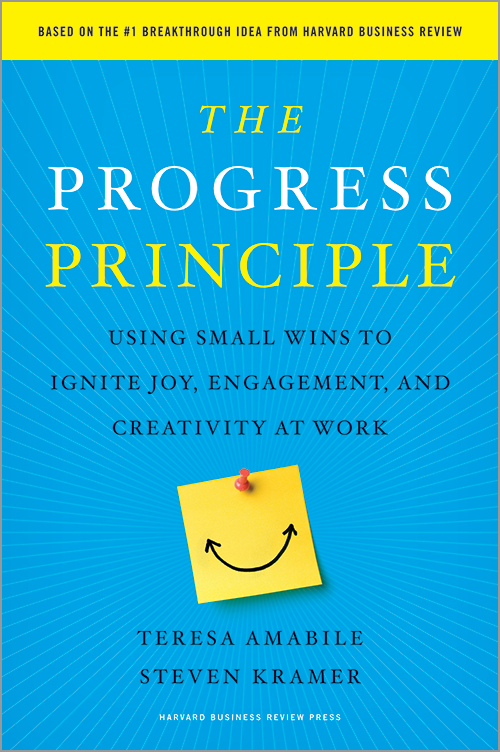
Image source: HBR Store - Harvard Business Review
How Did the 12,000 Diary Entry Study Change Management?
The scientific rigor behind the Progress Principle is what sets it apart from typical management theory. The study involved a massive data set: nearly 12,000 daily diary entries collected from 238 knowledge workers across seven different companies. These workers were asked to record their emotions, perceptions of the workplace, and their level of motivation at the end of every workday.
By analyzing these entries, Amabile and Kramer were able to map the "inner work life" of employees in real-time. They discovered that even mundane workday events could significantly impact performance. When workers made progress, they reported higher levels of happiness, more positive perceptions of their colleagues, and a stronger drive to continue working the next day. Conversely, on days marked by setbacks, these metrics plummeted.
The study, which has garnered over 1,650 academic citations, fundamentally changed the understanding of management by shifting the focus from macro-outcomes to micro-experiences. It proved that the manager’s role is not just to judge output, but to facilitate the daily conditions that allow progress to happen. As noted in Harvard Business School faculty summaries, the day-to-day events of a worker's life are the primary determinants of their long-term value to the organization.
Landmark Publication: The HBR article "The Power of Small Wins" and the book "The Progress Principle" are released, introducing the concept of Inner Work Life.
Academic Validation: The study becomes a cornerstone of organizational psychology, cited in thousands of papers regarding intrinsic motivation.
Remote Work Shift: The principle is adapted for distributed teams, focusing on how digital tools can replace physical "nourishers."
AI Integration: Modern teams use AI as "artificial catalysts" to break down complex tasks and maintain momentum during deep work phases.
What Is Inner Work Life and Why Does It Matter?
Inner work life is the psychological intersection of three distinct components that occur within a person during the workday. Understanding these components is essential for any leader who wishes to apply the Progress Principle effectively.
- Emotions: These are the gut-level feelings a person experiences, ranging from the joy of a breakthrough to the frustration of a technical glitch. Positive emotions are highly correlated with creativity.
- Perceptions: This involves how workers interpret their environment. Do they perceive their manager as supportive or micromanaging? Do they see their colleagues as teammates or competitors?
- Motivation: Specifically, the study focuses on intrinsic motivation—the internal drive to do work because it is interesting, challenging, or meaningful.
These three elements form a "Performance Loop." When a worker experiences a small win, their emotions improve, their perceptions of the company become more positive, and their intrinsic motivation increases. This leads to higher productivity and creativity, which naturally leads to more progress. However, the research also uncovered a sobering reality: the Negative Effect. Setbacks and inhibitors have a 2-3x stronger negative impact on inner work life than progress has a positive impact. A single "toxic" interaction or a major resource blockage can wipe out the motivational gains of several small wins.
Catalysts vs. Nourishers: How to Support Your Team
To facilitate progress, managers must understand the two primary forces that support inner work life: Catalysts and Nourishers. While they both contribute to momentum, they address different needs of the worker.
Catalysts (Work-Focused)
These are events that directly support the completion of the task. They are structural and functional in nature.
- Setting clear, achievable goals.
- Providing autonomy in how work is done.
- Ensuring sufficient resources and time.
- Learning openly from problems and failures.
Nourishers (Interpersonal-Focused)
These are events that support the person emotionally and socially. They build the human connection within the team.
- Offering verbal encouragement.
- Demonstrating respect for the worker's expertise.
- Fostering a sense of collegiality and belonging.
- Providing emotional support during setbacks.
In contrast, managers must avoid Inhibitors (the opposite of catalysts, like shifting goals or lack of resources) and Toxins (the opposite of nourishers, like discouragement or disrespect). In the modern digital workplace, the way these forces manifest has evolved significantly.
| Category | 2011 Example (Office) | 2026 Example (Remote/Digital) |
|---|---|---|
| Catalyst (Resource) | Access to the office printer/files. | Seamless API access and cloud permissions. |
| Catalyst (Goal Setting) | Monday morning whiteboard meeting. | Real-time Notion/Jira status dashboards. |
| Nourisher (Recognition) | A "pat on the back" in the hallway. | Progress-linked Slack "Reacji" or shout-outs. |
| Nourisher (Connection) | Coffee break conversations. | Asynchronous "Wins" channels and video huddles. |
How to Apply the Progress Principle in Remote and Hybrid Teams
In 2026, the greatest challenge to the Progress Principle is the "invisibility" of work. In a traditional office, a manager could see a team member hunched over their desk, signaling deep work, or hear the cheer when a bug was fixed. In a remote or hybrid environment, these signals are often lost in the void of asynchronous communication.
To overcome this, leaders must implement Digital Nourishers. This involves moving beyond generic praise like "Good job team" and toward "Progress-Linked Recognition." For example, a manager might post in a shared channel: "The small win Sarah achieved today by optimizing the database query has unblocked the entire front-end team for the rest of the week." This specific acknowledgement connects the individual's progress to the team's meaningful goal, amplifying the psychological boost.
Furthermore, teams should utilize Micro-Catalysts. These are automated or low-friction signals of progress. Using tools like Jira or Linear to automatically notify the team when a task moves from "In Progress" to "Review" creates a digital heartbeat of momentum. A case narrative from a leading remote marketing firm shows that by creating a dedicated "Daily Wins" channel where employees post one bullet point of progress each afternoon, the team reduced status-update meetings by 40% while increasing overall engagement scores.
Are You Falling Into the Small Win Trap?
While small wins are highly effective, they are not a magic bullet. The research by Amabile and Kramer explicitly states that progress only boosts motivation if the work is perceived as meaningful. If a worker feels their tasks are pointless or that their company’s mission is unethical, checking off items on a to-do list will not improve their inner work life.
This leads to the danger of "Productivity Theater." In the age of digital notifications, it is easy to fall into the trap of achieving "Dopamine Wins"—answering 50 trivial emails, attending low-value meetings, or tweaking the font on a slide deck. While these feel like progress, they often act as inhibitors to deep, meaningful work. Leaders must help their teams distinguish between "Catalytic Wins" (those that move the needle on core objectives) and "Busywork."
Before celebrating a win, ask these three questions:
- Is this task directly linked to a core project objective?
- Does this progress unblock a teammate or improve a shared process?
- If this task were never done, would the final outcome of the project change?
As noted in interviews with the American Management Association, progress can sustain motivation even under high pressure—such as tight deadlines or long hours—provided the work feels significant. Without meaning, progress is just activity.
How to Use AI as an Artificial Catalyst for Progress
In the current era, Artificial Intelligence has emerged as a top-tier tool for facilitating the Progress Principle. AI can act as an "Artificial Catalyst" by removing the common inhibitors that stall momentum.
- Overcoming the "Blank Page" Inhibitor: One of the most common setbacks in knowledge work is the inability to start. Using AI to generate an initial draft, outline, or brainstorm list provides an immediate "small win" that the worker can then refine, creating instant momentum.
- Task Decomposition: Large, daunting projects are often inhibitors because they feel insurmountable. Modern workers use Large Language Models (LLMs) to break a 40-hour project into thirty 15-minute "micro-tasks." Each completed micro-task serves as a small win, keeping the inner work life positive.
- AI as a Feedback Loop: AI tools can now summarize a week’s worth of digital activity to highlight where progress was made and where inhibitors (like excessive meetings) occurred. This allows workers to adjust their workflows before a setback becomes a trend.
Image source: Lifestack
A 5-Minute Daily Workflow to Track Your Small Wins
Self-monitoring is a highly effective way to leverage the Progress Principle, even if your manager is not actively providing nourishers. Teresa Amabile recommends keeping a "Progress Log" to track your own daily journey. This practice helps you recognize your own achievements and identify the inhibitors that are slowing you down.
The 3-Question Daily Template
Set a recurring calendar invite for the last five minutes of your workday to answer these three questions:
- What was my most significant small win today? (Focus on the task that felt most meaningful, not just the one that took the most time.)
- What catalyst (tool, person, or event) helped me achieve it? (Identifying these helps you replicate success in the future.)
- What inhibitor slowed me down, and how can I remove or mitigate it tomorrow? (This turns a setback into a plan for progress.)
By documenting these wins, you create a "paper trail" of success that can be used during performance reviews or simply as a personal motivational tool during difficult weeks. As Amabile notes in her 99U talk, the act of recording progress is itself a small win that boosts inner work life.
Frequently Asked Questions
The Bottom Line
Teresa Amabile’s Progress Principle remains a cornerstone of modern management because it addresses the fundamental human need for agency and achievement. To lead effectively in 2026, remember these key takeaways:
- Progress is the #1 driver of a positive inner work life and long-term employee engagement.
- Small wins build momentum, creating a performance loop that enhances creativity and productivity.
- Managers must be facilitators, focusing on providing "Catalysts" (resources/goals) and "Nourishers" (respect/support).
- Setbacks are highly potent, having a much stronger negative impact than progress has a positive one; removing inhibitors is as important as celebrating wins.
- Meaning is the prerequisite; progress in tasks perceived as pointless does not yield the same motivational benefits.
- Digital tools and AI should be used to make progress visible and to break down complex barriers in remote environments.
Start tomorrow by asking your team one simple question: "What was your most significant small win today, and how can I help you achieve another one tomorrow?"