How Many Hours Are in a Month and How to Calculate Them
- Total Hours in an Average Month: 730.5 hours
- Standard Working Hours per Month: 173.33 hours (based on a 40-hour week)
- Hours in a 31-Day Month: 744 hours
- Hours in a 30-Day Month: 720 hours
- Hours in a 28-Day Month: 672 hours
Whether you are a freelance professional calculating billable time, a human resources manager pro-rating a new hire's salary, or a cloud architect forecasting server costs, understanding exactly how many hours are in a month is a foundational metric. While the question seems straightforward, the answer changes significantly depending on whether you are looking at chronological time, standard payroll averages, or highly precise astronomical calendars.
Because months vary in length from 28 to 31 days, relying on a simple four-week estimation often leads to inaccurate budgeting and payroll errors. In this comprehensive breakdown, we will explore the exact mathematical averages used by modern industries, how to calculate your true working hours, and strategies for budgeting your disposable time effectively.
How Many Total Hours Are in Each Month of the Year
To determine the absolute chronological hours in any given month, the calculation is a simple matter of multiplying the number of days in that specific month by 24 hours. However, because the Gregorian calendar features months of varying lengths, the total hours fluctuate significantly throughout the year.
Breakdown by Month Length
The standard calendar year consists of 8,760 hours (or 8,784 hours during a leap year). When divided among the twelve months, we see three distinct categories of month lengths, plus the unique case of February.
(Jan, Mar, May, Jul, Aug, Oct, Dec)
(Apr, Jun, Sep, Nov)
(February - Common Year)
(February - Leap Year)
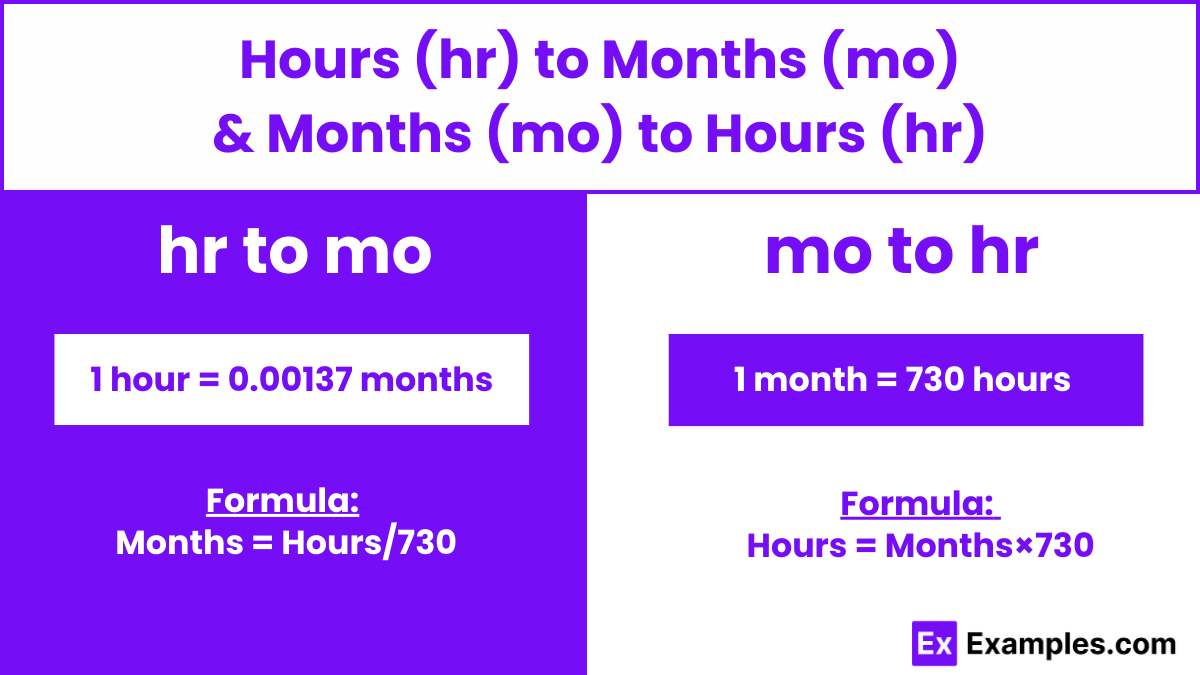
Image source: Examples.com
The Mathematical Average Month
When businesses, software platforms, and scientific institutions need to calculate a monthly average that applies universally across the year, they cannot simply use 720 or 744. Instead, they rely on mathematical averages. Interestingly, there are two distinct ways to calculate this average, depending on the level of precision required.
- The Julian Average (730.5 Hours)
- This is the standard business and commercial average. It is calculated by taking a standard year of 365 days, adding the leap year quarter-day (365.25 days), and dividing by 12 months. This results in 30.4375 days per month. Multiplied by 24 hours, you get exactly 730.5 hours. This is the figure used by almost all financial software, SaaS billing engines, and general forecasting models.
- The Gregorian Average (730.485 Hours)
- For high-precision scientific, astronomical, and server-uptime calculations, the Julian calendar is slightly inaccurate because it overestimates leap years. The modern Gregorian calendar dictates that a year is precisely 365.2425 days long. Divided by 12, this yields 30.436875 days per month, which equals 730.485 hours. While a difference of 0.015 hours (less than one minute) per month seems negligible, it becomes highly relevant when calculating 99.999% ("five nines") server uptime service level agreements (SLAs) over decades.
How to Calculate Working Hours for Payroll and Billing
While chronological hours are important for machines and billing cycles, human resources departments and project managers are primarily concerned with working hours. A common mistake made by novice freelancers and small business owners is assuming that a month consists of exactly four weeks (160 working hours). This assumption leads to significant underbilling and payroll discrepancies.
The Standard 40-Hour Week Formula
To find the true average of working hours in a month, you must account for the fact that a year is 52.14 weeks long, not exactly 52. According to standard payroll practices outlined by time-tracking authorities like TimeTackle, the correct formula for calculating average monthly working hours is:
(40 hours per week × 52 weeks in a year) ÷ 12 months = 173.33 hours per month.
This 173.33-hour figure is the bedrock of salaried compensation. When an employer quotes an annual salary of $60,000, the hourly equivalent is calculated based on 2,080 annual working hours (which divides down to 173.33 hours monthly), resulting in an hourly rate of roughly $28.85.
Monthly Variance Based on Weekdays
While 173.33 is the mathematical average, no single month actually contains exactly 173.33 working hours. Because months have different lengths and start on different days of the week, the actual number of working days (Monday through Friday) fluctuates between 20 and 23 days per month.
| Number of Workdays | Total Working Hours (8-hour day) | Typical Occurrence |
|---|---|---|
| 20 Workdays | 160 Hours | February, or months with multiple major holidays |
| 21 Workdays | 168 Hours | Common in 30-day months |
| 22 Workdays | 176 Hours | Common in 31-day months |
| 23 Workdays | 184 Hours | Occurs in 31-day months starting on a weekday |
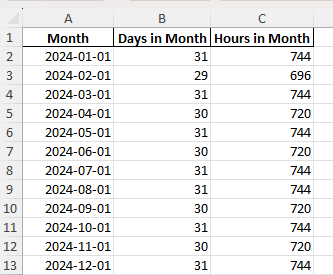
Image source: My Excel Online
How HR Handles the Payroll Midpoint
The variance in monthly working hours creates a complex administrative challenge when an employee is hired or terminated in the middle of a month. If a month has 23 working days (184 hours) and an employee starts halfway through, how is their first paycheck calculated?
To solve this, large institutions utilize a standardized "midpoint" strategy. For example, the UC Berkeley Controller's Office establishes a strict monthly working hours calendar that dictates exactly how many hours are in each specific month for that calendar year, accounting for university holidays.
In this system, the mathematical center of the month is often designated for administrative purposes. For a standard 31-day month, the midpoint is technically the 16th at 12:00 PM. If an employee begins work on the morning of the 16th, their salary is pro-rated based on the exact number of working hours remaining in that specific month's calendar, rather than a generic 50% cut of the 173.33 average. This ensures compliance with strict labor laws regarding hourly compensation.
How Many Hours Do You Actually Have for Yourself
Beyond payroll and billing, understanding the hours in a month is a powerful tool for personal time management and lifestyle design. When you look at the total 730.5 hours in an average month, it can feel like an abundance of time. However, once you subtract the non-negotiable requirements of daily living, your "True Free Time" shrinks dramatically.
The Disposable Time Budget Breakdown
To understand your actual time budget, we must apply a subtraction model to the average month. This framework helps visualize exactly where your time goes before you even have a chance to schedule hobbies, side projects, or relaxation.
- Total Monthly Baseline: 730.5 hours
- Minus Sleep: -243.5 hours (Assuming the recommended 8 hours per night)
- Minus Standard Work: -173.33 hours (Based on a 40-hour work week)
- Minus Commuting & Admin: -43.33 hours (Estimating 2 hours per workday for commuting, getting ready, and basic daily transitions)
- Minus Essential Chores: -30 hours (Estimating 1 hour per day for cooking, cleaning, and errands)
The Result: You are left with approximately 240.34 hours of true disposable time per month. This equates to roughly 8 hours per day, heavily weighted toward the weekends. Recognizing this limitation is crucial for setting realistic goals; if you plan a side project that requires 100 hours a month, you are committing nearly half of your total available free time to a single pursuit.
Deep Work vs. Clock Hours
When budgeting time for complex, cognitively demanding tasks, it is vital to distinguish between "Clock Hours" (time spent at a desk) and "Deep Work" (time spent in high-concentration flow states).
Insights gathered from developer communities, such as discussions on the Meteor developer forums, consistently reveal a "Productivity Cap." While a standard work month dictates 173.33 clock hours, human beings are rarely capable of sustaining deep cognitive effort for 8 hours straight.
Many experienced programmers, writers, and designers report that their maximum capacity for high-intensity output peaks at about 4 hours per day. If you apply this realistic metric to a standard 21-day work month, your actual monthly "Power Hours" amount to only 84 hours. Understanding this discrepancy is a significant advancement in project management, allowing freelancers and managers to set deadlines based on cognitive capacity rather than chronological availability.
The Impact of Hours on Cloud Services and SaaS Costs
The distinction between a 672-hour month (February) and a 744-hour month (January) is not just a matter of trivia; it has direct, tangible impacts on corporate budgets, particularly in the realm of cloud computing and Software as a Service (SaaS).
Why 744 Hours Matters for Your Budget
Major cloud infrastructure providers, such as Amazon Web Services (AWS), Microsoft Azure, and Google Cloud Platform (GCP), frequently bill for compute resources by the hour or even by the second. When you leave a server running continuously, the monthly cost will fluctuate based entirely on the calendar.
According to cloud architecture analyses by experts like Chris Tierney, failing to account for these fluctuations can lead to budget overruns. Consider a mid-sized database cluster that costs $2.50 per hour to operate:
- In January (31 days / 744 hours): The cost is $1,860.00.
- In February (28 days / 672 hours): The cost drops to $1,680.00.
- In April (30 days / 720 hours): The cost is $1,800.00.
This represents a nearly 10.7% variance in operational costs between January and February. For enterprise organizations running thousands of servers, this calendar-driven variance can amount to hundreds of thousands of dollars. This is precisely why many SaaS platforms that charge flat monthly fees base their internal cost-modeling on the Julian average of 730.5 hours, ensuring their profit margins remain stable regardless of the month.

Image source: WuKong Education
Working Hour Tables for Non-Standard Schedules
The 173.33-hour standard assumes a traditional 40-hour work week. However, modern employment is increasingly diverse, encompassing part-time roles, reduced-hour schedules, and high-intensity startup cultures.
According to career data platforms like Forage, the average person will work roughly 83,200 hours over their lifetime. How those hours are distributed monthly depends heavily on your chosen schedule. Below is a quick-reference guide for calculating average monthly hours based on non-standard weekly commitments (calculated using the `(Weekly Hours × 52) ÷ 12` formula):
| Schedule Type | Weekly Hours | Average Monthly Hours | % of Total Monthly Time (730.5 hrs) |
|---|---|---|---|
| Part-Time (Light) | 20 Hours | 86.67 Hours | 11.8% |
| Reduced Full-Time | 30 Hours | 130.00 Hours | 17.8% |
| Standard Full-Time | 40 Hours | 173.33 Hours | 23.7% |
| High-Intensity (Startup/Finance) | 50 Hours | 216.67 Hours | 29.6% |
| Extreme (Medical Residency/Law) | 60 Hours | 260.00 Hours | 35.6% |
As the table illustrates, moving from a standard 40-hour week to a 60-hour week doesn't just increase your workload; it consumes over a third of your total chronological existence for that month, severely impacting the "Disposable Time Budget" discussed earlier.
Strategies for Managing Your Monthly Hours
Knowing that you have exactly 730.5 hours in an average month is only useful if you actively manage how those hours are spent. Without a deliberate strategy, time tends to slip away into low-value activities.
Using the Eisenhower Matrix for Monthly Planning
One of the most highly regarded frameworks for time management is the Eisenhower Matrix, popularized by Stephen Covey. As detailed in time management strategies published by the University of Georgia, this matrix divides tasks into four quadrants based on urgency and importance:
- Urgent and Important: Crises, pressing problems, and deadline-driven projects. (Aim to minimize time spent here through better planning).
- Important but Not Urgent: Preparation, prevention, values clarification, and relationship building. (This is where you should spend the majority of your disposable monthly hours).
- Urgent but Not Important: Interruptions, some calls, some emails, and proximate pressing matters. (Delegate or batch these tasks).
- Not Urgent and Not Important: Trivia, busywork, and time-wasters like excessive scrolling. (Eliminate these entirely).
At the start of every month, audit your upcoming 730.5 hours. By intentionally scheduling tasks into Quadrant 2 (Important but Not Urgent), you prevent them from becoming Quadrant 1 emergencies later in the month, thereby gaining more control over your schedule.
The 1,440 Minute Rule
If looking at a month in terms of 730 hours feels too abstract, break it down to the daily level. Every single day contains exactly 1,440 minutes (or 86,400 seconds). Highly effective professionals often manage their time in minute-blocks rather than hour-blocks.
Consider the compound effect of small daily habits: If you can optimize your morning routine to save just 15 minutes a day, you reclaim 7.5 hours over the course of an average month. That is nearly an entire standard workday given back to your disposable time budget, simply by tightening up a daily process.
Frequently Asked Questions
How many working hours are in a month with 21 days?
In a month with exactly 21 working days (excluding weekends), there are 168 working hours, assuming a standard 8-hour workday. This is calculated simply by multiplying 21 days by 8 hours.
What is the average number of work hours in a month for a 40-hour week?
The standard average is 173.33 hours. This is calculated by taking 40 hours a week, multiplying it by 52 weeks in a year to get 2,080 annual hours, and then dividing that total by 12 months.
How many total hours are in a leap year?
A leap year contains 8,784 hours. This is 24 hours more than a standard common year, which contains 8,760 hours. The extra hours are added to the month of February, giving it 29 days (696 hours) instead of 28 days (672 hours).
Why do some people say there are 160 hours in a month?
People often estimate 160 hours by simply multiplying a 40-hour work week by 4 weeks. However, this is mathematically inaccurate because a month is slightly longer than 4 weeks (averaging 4.33 weeks). Using 160 hours for payroll or billing will result in underpayment.
How many hours are in a month minus sleep?
If you sleep the recommended 8 hours per night, you spend roughly 243.5 hours sleeping in an average month. Subtracting this from the total 730.5 hours leaves you with approximately 487 waking hours per month to divide between work, chores, and free time.
Final Thoughts on Monthly Time Management
Understanding the exact breakdown of hours in a month is essential for accurate payroll, precise cloud computing budgets, and effective personal time management. By moving away from rough estimates and utilizing exact mathematical averages, you can forecast costs and capacity with much greater accuracy.
- Use 730.5 for general averages: This Julian average is the standard for SaaS billing and general monthly forecasting.
- Use 173.33 for payroll: Never use 160 hours; the 173.33 average accounts for the true 52-week calendar year.
- Account for month length in cloud budgets: A 31-day month will cost roughly 10% more in hourly server fees than a 28-day month.
- Calculate your true free time: After sleep, work, and basic life administration, you have roughly 240 hours of disposable time per month.
- Plan for cognitive limits: Budget your complex tasks around a realistic 4-hour daily "Deep Work" capacity, rather than assuming 8 hours of peak productivity.
Take ten minutes today to calculate your personal disposable time budget for the upcoming month and block out your most important tasks accordingly.