500+ Funny Icebreaker Questions That Actually Make People Laugh
Funny icebreaker questions are low-stakes prompts designed to build psychological safety and encourage early participation in meetings. To avoid awkwardness, facilitators should enforce a 2-Minute Rule, make participation optional, and always answer the question first. A highly effective prompt for any group is: "What is a skill you have that is completely useless for this job?"
Starting a meeting with a blank stare from a grid of silent video squares is a universally uncomfortable experience. While standard small talk about the weather or weekend plans often falls flat, introducing a carefully selected, funny icebreaker question can dramatically shift the energy of a room.
However, there is a fine line between a prompt that sparks genuine laughter and one that induces collective cringing. As of mid-2026, workplace dynamics require a nuanced approach to team building—one that respects boundaries while still fostering connection. This comprehensive collection provides over 500 carefully categorized questions, alongside expert facilitation strategies, to ensure your next meeting starts on a high note.
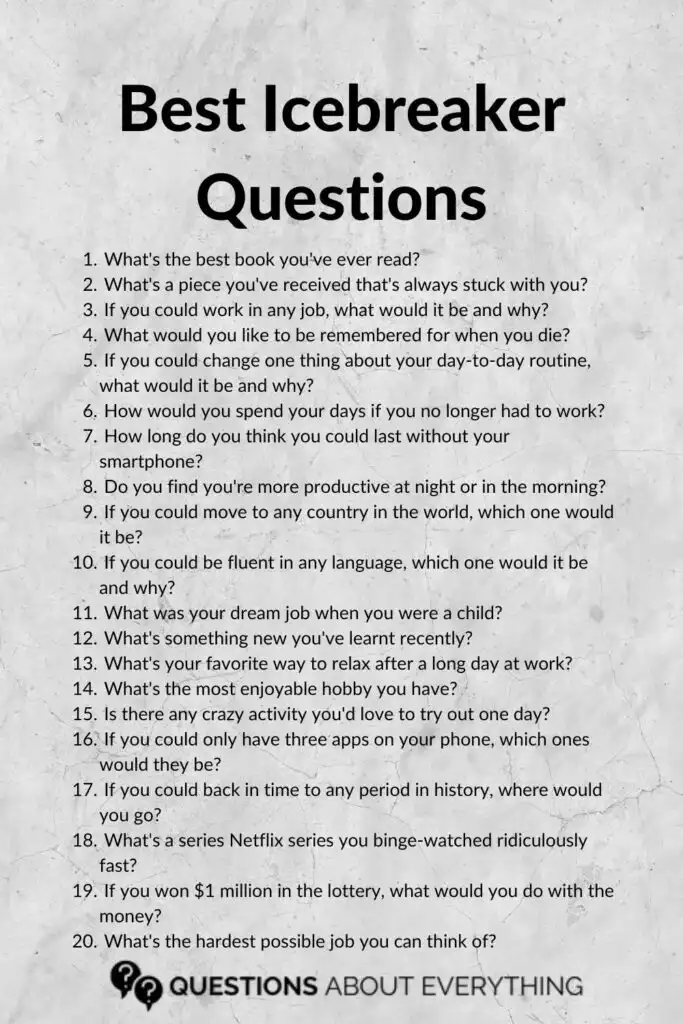
Image source: Questions About Everything
Why Funny Icebreakers Work Better Than Standard Small Talk
It is easy to dismiss icebreakers as corporate fluff, but behavioral science suggests otherwise. The primary function of these questions is not just to pass time; it is to establish a baseline of psychological safety.
When team members laugh together over a low-stakes topic—like debating whether a hotdog is a sandwich—they are subtly signaling to each other that the environment is safe for sharing opinions. According to facilitation experts at Mural, this early vocalization is critical. If a person speaks during the first five minutes of a meeting, they are significantly more likely to contribute to the core business discussion later on.
A foundational 1997 psychological study demonstrated that participants who shared personal (but guided) information felt significantly closer to one another than those who engaged in unstructured small talk. Psychologist Anton Villado notes that icebreakers serve to "hasten" this process of self-disclosure. By providing a structured prompt, facilitators remove the cognitive load of inventing conversation, allowing participants to focus entirely on connection.
Furthermore, humor acts as a natural equalizer. When a senior executive admits to a ridiculous childhood fear or a bizarre coffee order, it humanizes leadership and flattens the perceived hierarchy. This "Icebreaker ROI" means that investing five minutes in laughter often yields better collaboration, faster problem-solving, and higher engagement for the remaining 55 minutes of the agenda.
How to Facilitate Icebreakers Without Making It Awkward
Even a top-tier question can fail if the delivery is poor. The anxiety associated with "forced fun" is a real phenomenon in corporate environments. To mitigate this, facilitators must adopt a structured approach to asking questions.
Based on insights from retrospective tools like Parabol and TeamRetro, here are the non-negotiable rules for cringe-free facilitation:
- The Lead by Example Rule: The person asking the question must always answer it first. This establishes the expected length and vulnerability level of the response. If you ask a silly question and give a guarded answer, the team will follow suit.
- The Optional Participation Rule: Never force someone to speak. Establish a "safe to pass" culture. You can say, "We're going to go around the room. If you can't think of anything, just say 'pass' and we'll move to the next person."
- The 2-Minute Rule for Meetings: Icebreakers should not derail the agenda. For a standard 30-minute meeting, the entire exercise should take no more than two to five minutes. Use rapid-fire questions for larger groups, or only ask a subset of the team to answer each week.
- Active Listening and Validation: When someone shares an answer, the facilitator should offer a brief, validating response (e.g., "I completely agree," or "I never thought of it that way") before moving on. Silence after an answer creates awkwardness.
Funny Icebreaker Questions for Professional Meetings
When dealing with new teams, cross-functional groups, or external clients, it is wise to stick to topics that are universally relatable and carry zero risk of crossing personal boundaries. These questions focus on lighthearted workplace observations and safe nostalgia.
The "Firsts" Category
Nostalgia is a powerful bonding tool. Discussing early life experiences reminds everyone that they all started somewhere.
- What was your very first paying job?
- What was the first car you ever drove, and what was wrong with it?
- What was the first concert you ever attended?
- What is the first thing you bought with your own money?
- What was your first screen name or email address?
- What was the first CD, cassette, or vinyl you ever owned?
- What was your first impression of the internet?
- What was the first meal you learned how to cook?
- What was your first favorite movie as a kid?
- What was the first video game you ever played?
- What was your first smartphone?
- What was the first rule you remember breaking as a kid?
- What was your first fashion disaster?
- What was the first thing you thought about when you woke up today?
- What was your first pet's name?
- What was the first book you remember genuinely enjoying?
- What was your first experience with a computer like?
- What was the first app you downloaded on your current phone?
- What was your first Halloween costume?
- What was the first thing you learned to do at your current job?
- What was your first major purchase as an adult?
- What was the first country you visited outside your own?
- What was your first favorite band?
- What was the first thing you burned in the kitchen?
- What was your first experience with public speaking?
- What was the first piece of advice a mentor gave you?
- What was your first impression of our company?
- What was the first thing you did last weekend?
- What was your first favorite TV show?
- What was the first sport you ever tried to play?
Workplace Hypotheticals
These prompts allow teams to playfully critique their work environment without generating actual conflict.
- If our team were a 90s sitcom, what would our theme song be?
- If you had to give a 10-minute presentation right now with zero preparation, what topic would you choose?
- If our company had a mascot, what animal would it be and why?
- If you could instantly automate one minor annoyance in your workday, what would it be?
- If your work style was a genre of music, what would it be?
- If you could replace the office coffee machine with a dispenser for any other liquid, what would it be?
- If you had to work from a fictional universe for a week, which one would you choose?
- If your inbox had an honest out-of-office auto-reply, what would it say?
- If you could ban one corporate buzzword forever, which one is gone?
- If our team was stranded on a desert island, who would be the first to build a shelter?
- If you could teleport to any location for your lunch break, where are you going?
- If you had to wear a uniform to work every day, what would you design?
- If you could only use three keyboard shortcuts for the rest of your life, what are they?
- If your desk could talk, what would it complain about?
- If you were forced to switch jobs with anyone in the company for a day, who would it be?
- If you could add one ridiculous perk to our benefits package, what is it?
- If every meeting had a halftime show, what would yours be?
- If you had to describe your current project using only a movie title, what is it?
- If you could have a remote control that only works on your coworkers, what buttons would it have?
- If you were a professional wrestler, what would your entrance music be when joining a Zoom call?
- If you could instantly master any software program, which one would it be?
- If you had to communicate entirely in emojis for a day, how would you survive?
- If your career was a board game, which one would it be?
- If you could hire a personal assistant to do exactly one task for you, what is it?
- If you had to write a book about your career so far, what would the title be?
- If you could change the company's dress code to anything, what would it be?
- If you were in charge of the office playlist, what is the first song?
- If you could have any view out of your office window, what would you choose?
- If you had to summarize your job in three words, what are they?
- If you could invent a new holiday for the workplace, what would we celebrate?
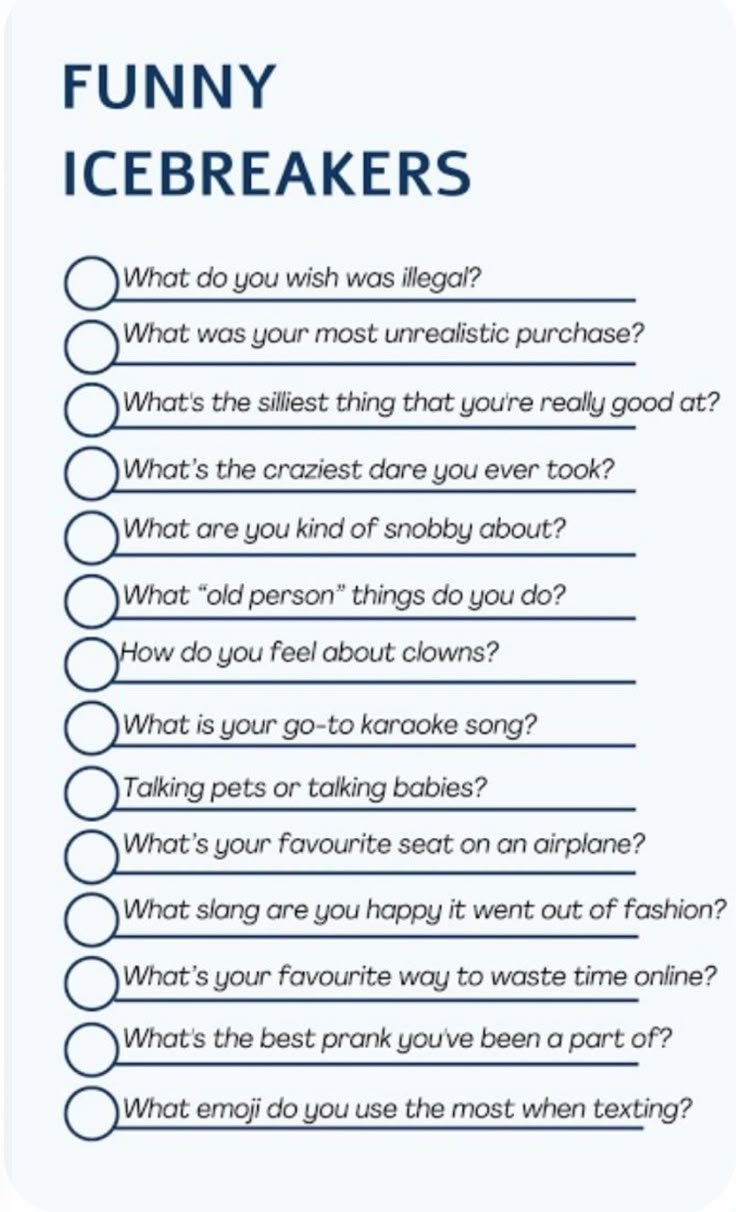
Image source: Pinterest
The "Anti-Resume"
According to Surf Office, discussing anti-skills is a highly effective way to build humility and humor within a group.
- What is a skill you have that is completely useless for this job?
- What is something you are spectacularly bad at?
- What is a topic you could easily fail a test on right now?
- What is the most embarrassing thing you’ve ever put on a resume?
- What is a common task that everyone else finds easy, but you struggle with?
- What is the worst job interview experience you’ve ever had?
- What is a hobby you tried to pick up but immediately abandoned?
- What is a piece of technology you still don't understand how to use?
- What is the most ridiculous mistake you made at your first job?
- What is a word you consistently misspell or mispronounce?
- What is a popular productivity hack that absolutely does not work for you?
- What is the most useless certification or award you hold?
- What is a subject you studied in school that you have entirely forgotten?
- What is a DIY project you attempted that ended in disaster?
- What is a sport you are dangerously uncoordinated at?
- What is a language you tried to learn but gave up on?
- What is a musical instrument you are terrible at playing?
- What is a household chore you are notoriously bad at completing?
- What is a piece of common sense you learned embarrassingly late in life?
- What is a trend you tried to follow that did not suit you at all?
- What is a food you have tried multiple times but still cannot cook properly?
- What is a game you always lose?
- What is a piece of trivia you know that is entirely unhelpful?
- What is a habit you have that makes you a terrible roommate?
- What is a movie plot you still don't understand even after watching it?
- What is a direction (North, South, East, West) you constantly get confused?
- What is a basic math concept you still use your fingers for?
- What is a piece of modern slang you use incorrectly?
- What is a social norm you frequently forget to follow?
- What is a professional skill you pretend to have but actually just Google every time?
Weird and Absurd Questions to Spark Creative Thinking
When a team is facing a creative block or preparing for a brainstorming session, standard questions won't cut it. You need prompts that force the brain to make unusual connections. These questions lean into the abstract and the slightly absurd.
Sensory and Abstract Prompts
- If the color blue had a smell, what would it be?
- If clouds came in flavors, what flavor should today's sky be?
- What texture makes you instantly uncomfortable?
- If you could only hear one sound for the rest of your life, what would it be?
- What does the concept of "Tuesday" taste like?
- If your personality was a weather pattern, what would the forecast be?
- If you had to describe your mood today using only a temperature, what is it?
- What is a smell that instantly triggers a specific childhood memory?
- If you could see music, what song would look the most beautiful?
- If you had to assign a color to the feeling of finishing a big project, what is it?
- What is the most satisfying sound in the world?
- If you could taste words, which word would be the most delicious?
- If your energy level right now was a type of lighting, what would it be?
- What is a texture you absolutely love touching?
- If you could bottle the smell of your favorite place, what would the label say?
- If you had to navigate the world using only echolocation, what sound would you make?
- What is a sound that instantly puts you to sleep?
- If you could change the color of the ocean, what would you choose?
- If you had to describe your work style as a type of fabric, what is it?
- What is a smell that most people hate but you secretly enjoy?
- If you could only eat foods that are one specific color, what color would you choose?
- If you had to assign a musical instrument to your inner monologue, what is it?
- What is the most jarring sound to wake up to?
- If you could feel the texture of any planet in the solar system, which one would you touch?
- If your sense of humor had a flavor, what would it be?
- What is a sound you associate with pure panic?
- If you could change the sound of your own sneeze, what would it sound like?
- If you had to describe your weekend plans as a painting style, what is it?
- What is a smell that tells you a season is changing?
- If you could only wear clothes made of one material forever, what is it?
The "Cringe" Factor
Sharing minor embarrassments is a proven way to build trust. These questions are designed to be funny without crossing into deeply personal territory.
- What is an "old person habit" you have developed recently?
- What is the most cringey fashion phase you went through?
- What is a movie you loved as a kid that is actually terrible?
- What is a song you know all the words to but are embarrassed to admit?
- What is the most ridiculous thing you believed as a child?
- What is a slang word you used to say constantly that makes you cringe now?
- What is the most embarrassing thing you’ve done on a video call?
- What is a weird food combination you eat when no one is watching?
- What is the most dramatic thing you did as a teenager?
- What is a completely irrational fear you still have?
- What is the most embarrassing injury you’ve ever sustained?
- What is a TV show you watch purely for the drama?
- What is the most ridiculous thing you’ve ever purchased late at night?
- What is a nickname you had that you absolutely hated?
- What is the most awkward encounter you’ve had with a stranger?
- What is a lie you told as a kid that spiraled out of control?
- What is the most embarrassing thing your parents did in front of your friends?
- What is a trend you participated in that you hope the internet forgets?
- What is the most ridiculous argument you’ve ever been in?
- What is a habit you have that you know is annoying to others?
- What is the most embarrassing thing you’ve ever Googled?
- What is a phase you went through that your family still teases you about?
- What is the most awkward text you’ve ever accidentally sent to the wrong person?
- What is a fear you have that makes zero logical sense?
- What is the most ridiculous thing you’ve cried over?
- What is a piece of advice you gave someone that was actually terrible?
- What is the most embarrassing thing you’ve done to impress a crush?
- What is a weird collection you used to have?
- What is the most awkward silence you’ve ever endured?
- What is a mistake you made that you tried to cover up but failed miserably?
Would You Rather Questions That Start Hilarious Debates
The "Would You Rather" format is a staple of team building because it forces a choice, eliminating the dreaded "I don't know" response. According to EasyRetro, framing these as low-stakes debates generates the highest level of engagement.
Would you rather give up coffee forever or give up all forms of sugar forever?
Would you rather eat pizza for every meal or tacos for every meal?
Would you rather have to eat a raw onion like an apple or drink a shot of hot sauce?
Would you rather be able to read minds but never turn it off, or be invisible but only when you hold your breath?
Would you rather fly at 5 mph or run at 100 mph?
Would you rather have the ability to talk to animals or speak every human language?
Would you rather always have to hop everywhere or always have to talk like a pirate?
Would you rather have spaghetti for hair or sweat maple syrup?
Would you rather fight one horse-sized duck or a hundred duck-sized horses?
More Low-Stakes Conflict Prompts
- Is a hotdog a sandwich? (Defend your answer).
- Does pineapple belong on pizza?
- Is cereal a soup?
- Would you rather always be 10 minutes late or 20 minutes early?
- Would you rather lose your phone for a week or your car for a month?
- Would you rather have a rewind button for your life or a pause button?
- Would you rather only be able to whisper or only be able to shout?
- Would you rather have a constantly itchy nose or a piece of food always stuck in your teeth?
- Would you rather fight a bear in a swimming pool or a shark on land?
- Would you rather never use the internet again or never take an airplane again?
- Would you rather have fingers for toes or toes for fingers?
- Would you rather always feel like you have to sneeze or always feel like you are about to fall?
- Would you rather wear winter clothes in the summer or summer clothes in the winter?
- Would you rather have to announce every time you enter a room or every time you leave a room?
- Would you rather only be able to listen to one song for the rest of your life or never listen to music again?
- Would you rather have a personal chef or a live-in house cleaner?
- Would you rather be trapped in a romantic comedy or a horror movie?
- Would you rather always have a song stuck in your head or always have an itch you can't reach?
- Would you rather give up watching TV/movies or give up playing video games?
- Would you rather have to sleep in jeans every night or wear a suit to the beach?
Modern Icebreakers for Gen Z and Remote Teams
Workplace demographics are shifting, and so is the language of connection. Utilizing modern internet slang and concepts can make icebreakers feel fresh and relevant, particularly for younger teams.
The "Roman Empire" and "Beige Flags"
These prompts borrow from popular social media trends to uncover quirky personality traits.
- The Roman Empire: What is a random historical event, pop culture moment, or obscure fact that you think about every single day for no reason?
- Beige Flags: What is a "beige flag" you have? (A trait that isn't good or bad, just slightly weird—like setting alarms for 7:03 instead of 7:00).
- Canon Events: What was a "canon event" in your career? (An unavoidable moment that fundamentally changed your trajectory).
- What is a hill you are absolutely willing to die on regarding a trivial topic?
- What is your most controversial food opinion?
- If you had to give a TED Talk on a topic you are entirely unqualified for, what would it be?
- What is a piece of media (movie, game, book) that fundamentally altered your brain chemistry?
- What is the most niche internet drama you have ever been heavily invested in?
- What is a hyper-fixation you had recently that lasted exactly one week?
- If you were an NPC (Non-Playable Character) in a video game, what would your idle animation be?
- What is a "life hack" you saw on TikTok/Reels that actually works?
- What is the most chaotic energy you bring to the workplace?
- If you had to describe your aesthetic using three random objects, what are they?
- What is a conspiracy theory you don't actually believe, but find incredibly entertaining?
- What is your go-to strategy for escaping an awkward conversation?
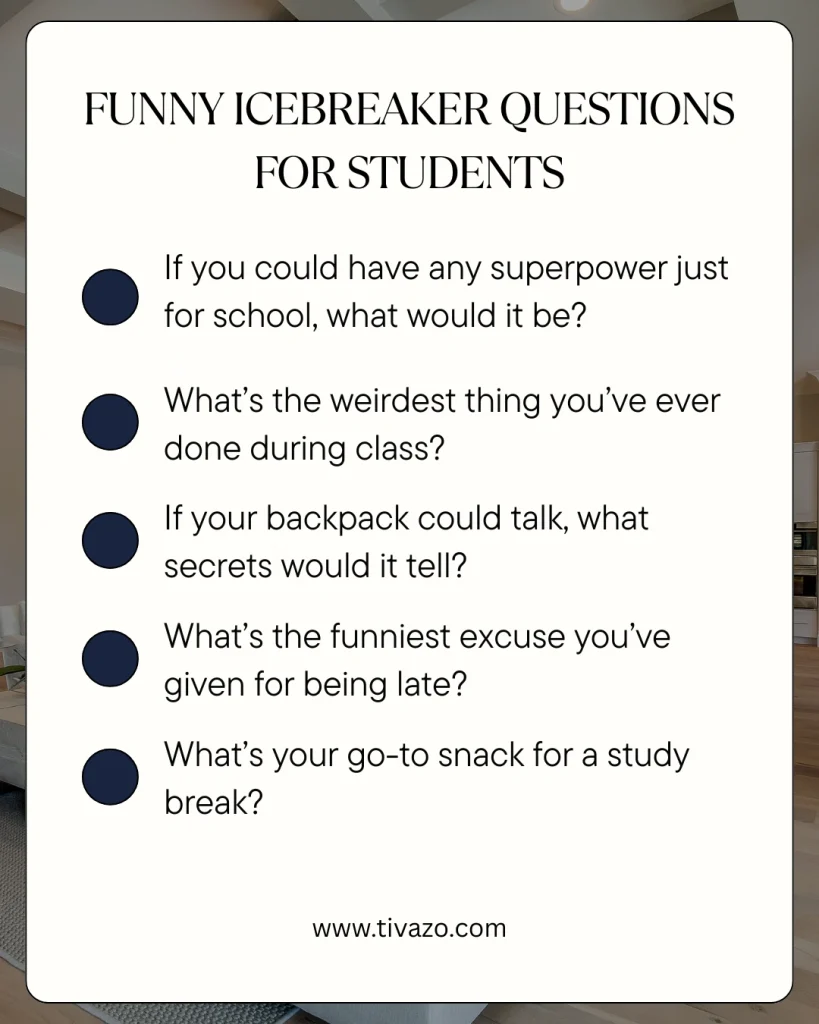
Image source: Tivazo
Virtual-Specific "Show and Tell"
For remote teams on Zoom or Microsoft Teams, physical movement and visual aids break up the monotony of staring at faces.
- Without leaving your seat, show us the weirdest thing within arm's reach of your desk.
- Change your virtual background to a picture of your dream vacation spot.
- Show us the last photo you took on your phone (if it's safe for work).
- Hold up your favorite coffee mug and explain the story behind it.
- What is the most chaotic thing happening just off-camera right now?
- Show us a piece of desk decor that brings you joy.
- If you have a pet nearby, bring them on camera for a formal introduction.
- Hold up the book you are currently reading or the last book you finished.
- Show us your go-to work-from-home snack.
- What is the most unusual item you keep on your desk for productivity?
- Change your background to a scene from your favorite movie.
- Show us a plant you are currently trying to keep alive.
- Hold up an item that represents a hobby you do outside of work.
- Show us the most colorful thing in your workspace.
- What is the oldest item currently sitting on your desk?
Quick-Fire Questions for 2-Minute Meeting Starts
When you are pressed for time, long-form answers are not viable. Quick-fire questions require only a single word, a raised hand, or an emoji in the chat. These are highly recommended for large all-hands meetings.
Rapid Choice (This or That)
- Coffee or Tea?
- Early bird or Night owl?
- Cats or Dogs?
- Sweet or Savory?
- Mountains or Beach?
- Winter or Summer?
- Books or Movies?
- Calls or Texts?
- Pancakes or Waffles?
- Invisibility or Flight?
- Comedy or Horror?
- Dine in or Delivery?
- Window seat or Aisle seat?
- Pen or Pencil?
- Mac or PC?
- Morning workout or Evening workout?
- Audiobook or Podcast?
- Board games or Video games?
- City or Countryside?
- Introvert or Extrovert?
One-Word and Emoji Check-Ins
- Describe your mood today using only a movie title.
- Drop the emoji in the chat that best represents your weekend.
- In one word, how are you feeling about this upcoming project?
- What is your current energy level on a scale of 1-10?
- Type the first word that comes to mind when I say "Friday."
- Use an emoji to describe the weather where you are right now.
- In one word, what is your biggest priority today?
- Drop a GIF in the chat that represents your current state of mind.
- What is one word to describe your breakfast this morning?
- Use an emoji to describe your commute (even if it's just to the living room).
How to Choose the Right Question for Your Group
Not all questions are created equal. A prompt that works brilliantly for a close-knit startup team might cause severe discomfort in a corporate board meeting. To navigate this, facilitators should use a Risk vs. Reward framework.
- The "HR-Safe" Guarantee
- Before asking any question, run it through this filter: Does it require someone to reveal their financial status, relationship status, religious beliefs, or physical health? If yes, discard it immediately. True psychological safety means no one feels exposed.
- Low-Risk Questions
- Focus on universal, external topics: Food, travel, pets, and mild preferences (e.g., "Coffee or Tea?"). These are ideal for new teams, interviews, or cross-departmental meetings where trust has not yet been established.
- Medium-Risk Questions
- Focus on personal history and mild vulnerability: Childhood memories, first jobs, and funny failures (e.g., "What is your most useless skill?"). These are suitable for established teams that meet regularly and have a baseline of mutual respect.
- High-Risk Questions
- Focus on deep personal beliefs or edgy hypotheticals. These should generally be avoided in professional settings unless the team is exceptionally close or participating in an off-site retreat designed for deep bonding.
The Icebreaker Risk Matrix
| Context | Risk Level | Example Question | Expected Outcome |
|---|---|---|---|
| New Team / Client Call | Low | "What is your favorite pizza topping?" | Safe, easy participation. No anxiety. |
| Weekly Standup | Low-Med | "What is a beige flag you have?" | Light laughter, mild personality reveal. |
| Quarterly Retrospective | Medium | "What is a work task you are spectacularly bad at?" | Builds humility and empathy among peers. |
| Late Night Off-Site | High | "What is a hill you will absolutely die on?" | Deep debate, requires high existing trust. |
Frequently Asked Questions
What are some safe funny icebreakers for corporate meetings?
For strict corporate environments, stick to the "Firsts" category (first job, first car) or food debates (hotdog as a sandwich). These topics are universally relatable, carry zero risk of crossing HR boundaries, and naturally invite lighthearted humor without requiring deep vulnerability.
How do you introduce an icebreaker without it being awkward?
The key is to acknowledge the exercise and keep it brief. Say something like, "Before we dive into the metrics, let's take two minutes for a quick check-in." Then, immediately answer the question yourself to set the tone and demonstrate the expected length of the response.
What are the most effective funny icebreaker questions for virtual teams?
Virtual teams benefit from "Show and Tell" prompts. Asking participants to "show the weirdest thing within arm's reach" or "drop an emoji that represents your weekend" breaks the visual monotony of a video call and utilizes the unique features of the digital environment.
How many icebreaker questions should you ask in a 30-minute meeting?
Exactly one. The entire exercise should take no more than 2 to 5 minutes. If you ask multiple questions, you risk derailing the agenda and causing frustration among team members who are anxious to get to the core business topics.
What if someone refuses to answer the question?
Always respect a participant's right to pass. If someone hesitates or declines, smile, say "No problem, we'll move to [Next Person]," and continue smoothly. Forcing participation destroys psychological safety and guarantees the exercise will be remembered negatively.
Final Thoughts on Team Connection
Integrating humor into your meeting routine is a highly effective strategy for building a resilient, communicative team. By lowering the stakes of participation early in a meeting, you pave the way for deeper collaboration later on.
- Prioritize safety: Always vet questions to ensure they are inclusive and do not cross personal boundaries.
- Lead the way: The facilitator must answer first to establish the tone and vulnerability level.
- Watch the clock: Enforce the 2-Minute Rule to ensure the activity enhances the meeting rather than derailing it.
- Embrace modern slang: Use concepts like "Roman Empires" or "Beige Flags" to engage younger demographics.
- Make it optional: Allow team members to pass without judgment to maintain a low-pressure environment.
Select three questions from the "Low-Risk" category above and test one at the beginning of your next weekly standup.